
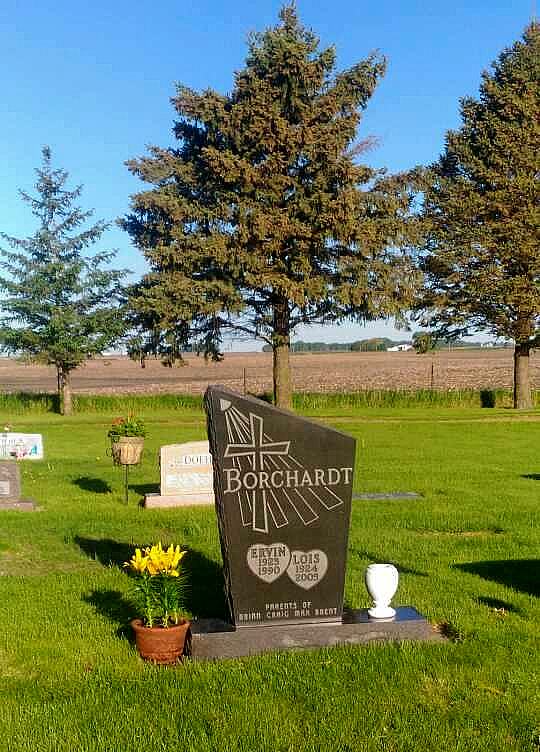
There’s a sight that brings a smile to my face when I stand a short distance in front of my parent’s gravestone. I can look out and see all the old farmers I grew up working for who lived near us: Eddie and Virgene Uthof, Lloyd and Dorothy Kern, and Willard and Hulda Menz. It’s like the old neighborhood is still together in a quiet little cemetery a half-a-mile out of town in the countryside.
This was a group of farmers who all grew up in the 1920’s and ’30’s and sharing equipment and labor for jobs like baling hay and shelling corn was common.When they had been teenagers, large crews of neighbors took turns using a 20-ton steam engine to power a machine called a thresher that separated grain from the plant stalks.
It was hard work but it was also an extremely important social event for the whole neighborhood. They were called Threshing Parties and there was a festive atmosphere to the whole enterprise. It took large crews of neighbors – men, women and children – to do the work and provide all the food required to pull off a big operation like that. I could tell from the way the old-timers talked that those had been some of the happiest days of their lives.
I was lucky enough to get a sense of what that life was like and to hear their stories, but even then I was aware that I was experiencing something that was ending and never coming back. The U.S. Secretary of Agriculture in the early 1970’s, a man named Earl Butz, told American farmers they should get big or get out. A few years ago, I talked on the phone with our neighbor, Virgene Uthof, on the night she passed away and we talked about how the old neighborhood was not like it used to be. It’s all big farmers now.
I think in many ways I have been looking for, and almost never finding, that same sense of camaraderie and appreciation in my own working life that I experienced with those old farmers then. I knew that I was working with others toward a common purpose and that my work was valued. I have almost never experienced that in my adult working life.
I was never really prepared for office politics. I seem to be a magnet for the petty, niggling coworker and the supervisor who acts as their enabler. I still feel like I have talents to give, but I work in a lot of places where I’m not really wanted on the team.
I even moved to a small town and owned a natural foods store because I wanted to be my own boss and feel a sense of connection to a community. Instead, I always felt like I was caught between a nativist group of townspeople who didn’t want outsiders coming to “their” town and the town’s cultural elites who did not think I was sophisticated enough to be in “their” town either.
I have wanted to have a sense of connection to others through my work and for my work to be treated as having value. For the most part, that has just not been the case.
When I think of how the old farmers I knew are now near each other in that cemetery back home, I think of Thornton Wilder’s play “Our Town” and how the characters at the end of the play speak to each other in the cemetery they now occupy. It’s an image of the afterlife that seems out of place in the world I inhabit.
Is there a human consciousness that lives on after we die or do our atoms just split up and find new adventures? If we are just atoms that split up, that actually doesn’t sound all that bad to me.
I like to imagine the afterlife being like a piece of music called “Star Dawn” by Alan Hovhaness. It’s a 14 minute-long symphony that imagines a space flight taking off from Earth and landing on a distant planet. The music of Alan Hovhaness reminds me of a spirit world because he uses bells a lot and when I hear the “tinkly” parts of his music I think of a world that people can sense but maybe not see because it is a world that exists within arm’s reach but just out of sight. In this piece, the “tinkly” sounds combine with “bing-bongy” sounds that make me think of flying through space. If my Spirit leaving sounded something like this music, I think I’d be okay with that.

Since the old neighborhood isn’t what it used to be and I don’t have the same connection to it anyway, I think I would like to wind up at The Neal Smith National Wildlife Refuge in Prairie City, Iowa.They are restoring the Iowa countryside to be like what the natural prairie was in 1840 before the land became dominated by industrialized agriculture. I honestly do not know if there is a personal God who knows the number of hairs on my head or if we are all part of The Energy that makes up The Universe, but if I could be a part of a landscape that can make use of me, well, then that sounds like a pretty satisfying way to live on.

 Schmecken!