
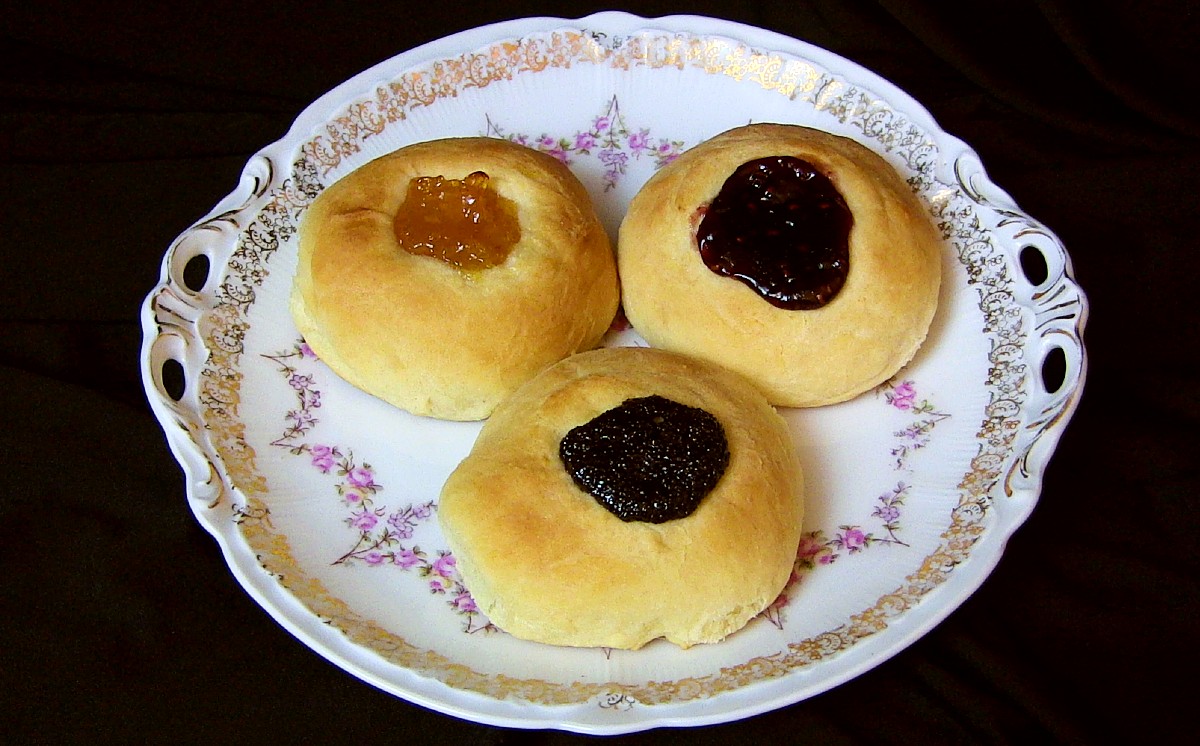
Kolaches are a pastry that is closely linked to the heritage of the Czech immigrants who settled in Eastern Iowa. This recipe may have come from a woman who emigrated from Bohemia in the mid-1800s and settled in the small but very important Czech community of Spillville, Iowa and was handed down through generations. It’s a heritage recipe and I’ve made an effort to preserve it in a modern recipe format so that it can live on while staying true to its authentic roots.
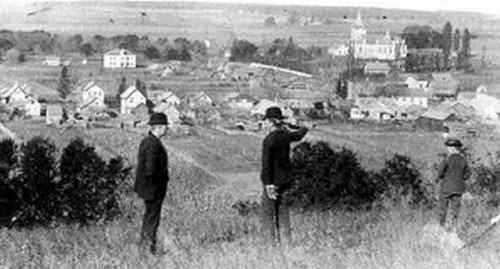
Who was Mrs. Cerny? That’s a mystery. However, clues point to Spillville, Iowa and the possibility that the famous Czech composer Antonin Dvořák was served kolaches made by Mrs. Cerny in the summer of 1893 when Dvořák spent a summer there among the Bohemian immigrants who formed that community and was inspired by the wide-open landscape to compose works that had a profound influence on American music.
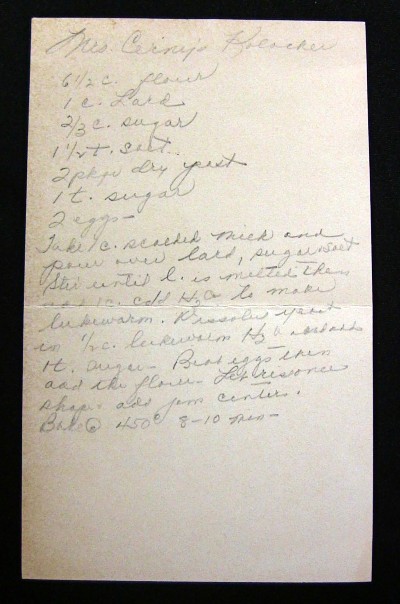
Her recipe, written in faded pencil on a blank piece of card stock by my partner Debra’s grandmother, was in the collection of family recipes Deb inherited when her mother passed away.
Deb’s grandmother, Irma, was born in Spillville, Iowa in 1907, married in 1930 and made her home in Iowa City from then on. She was a member of St. Wenceslaus Church in Iowa City, which is where Deb grew up learning how to make kolaches from all the Czech grandmas in the congregation. However, Deb does not have a recollection of a family named Cerny from her time growing up there.
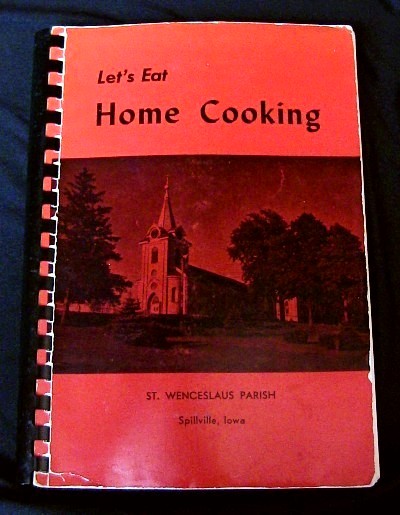
Even though there is no mention of Mrs. Cerny in a cookbook published by the St. Wenceslaus Parish of Spillville, Iowa called “Let’s Eat Home Cooking,” published in 1962, other recipes for kolaches in the book are very similar to the one attributed to Mrs. Cerny in Deb’s collection.
I did some detective work and I think it’s very likely that Mrs. Cerny was Marie Gottfried Cerny, who was born in 1828 or ’29 and lived in the village of Varvažov in the South Bohemian Region of the Czech Republic before emigrating to Spillville, Iowa with her husband Jan. She passed away in 1910, and she and Jan are the only people named Cerny who are buried in the St. Wenceslaus Cemetery in Spillville.


Marie Cerny’s nameplate on her grave
Marie and Jan Cerny raised a family in Spillville and there is a record of one of their daughters, Anna Frances Cerny, marrying in Spillville in 1871. Their roots in that community run deep. It seems entirely probable that when Deb’s grandmother went out into the world she took Mrs. Cerny’s recipe for kolaches with her because people in Spillville continued to respect Mrs. Cerny so much.
Antonin Dvořák was probably the most famous composer in the world when he served as the church organist at St. Wenceslaus Parish in Spillville, Iowa during the summer he spent there in 1893. I imagine he ate a kolache or two in the church basement that year. Marie Cerny, and Deb’s ancestors, would have been active members of the parish at that time.
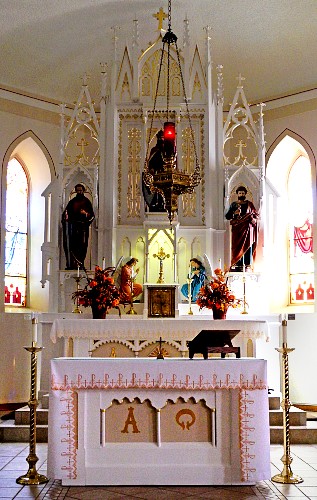
During the time he spent in Spillville, Dvořák felt at home with his Bohemian roots and the inspiration he derived from his time there led him to compose two works which now count among the most popular pieces of the international chamber repertoire: String Quartet No. 12 in F major, known as “The American String Quartet,” and String Quintet No. 3 in E flat major.
Iowa Public Television did a lovely little segment about this piece of Iowa history.
When I came across the faded, handwritten recipe for Mrs. Cerny’s Kolaches I thought it would be fun to make them as written and see how they turned out. As is often the case with old home recipes, the measurements were not as exact as people now expect. Experienced bakers can make adjustments on the fly because they have a good idea how dough is supposed to look; novice bakers may struggle and get frustrated. I believe I’ve stayed very true to her recipe with only a few minor tweaks that will aid anyone who tries to make these.
I’m happy to say the final product matches my memory of the kolaches I used to get at Sykora Bakery in the Czech Village of Cedar Rapids, Iowa when I lived there in the 1990s.

I was at the dedication ceremony of the National Czech & Slovak Museum & Library in Czech Village when Sykora Bakery was visited by President Bill Clinton, President Václav Havel of the Czech Republic and President Michal Kováč of Slovakia on October 21, 1995. According to the owner, Bill Clinton had a cherry kolache and Hillary Clinton had an apple strudel.
Deb and I are part of a unique generation that have links to people who were alive in the 19th century and can still recall the flavors of their cooking. I think it is important to keep some of these old, region-specific recipes alive.
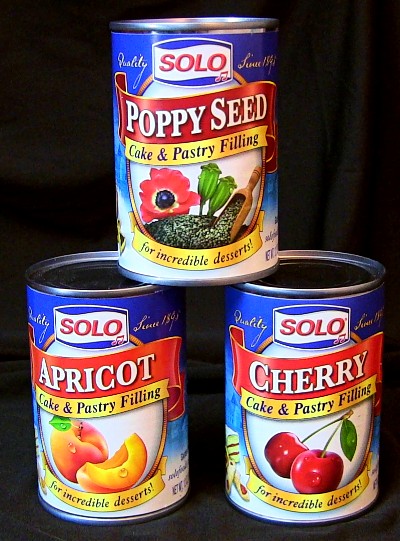
Instead of making the filling from scratch, I feel quite comfortable with using the ready-to-use pastry fillings from the Solo Foods Company. Solo Foods was founded by John Sokol, who was a Czechoslovakian immigrant who came to Chicago in 1889. Their flavors are about as authentic as it gets.
While we cannot say for certain who Mrs. Cerny was, it can certainly be asserted that Mrs. Cerny made a kolache worthy of acclaim.
Yield: 24 Kolaches
Ingredients:
- 820 grams (6 ⅔ cups) All-Purpose or Bread Flour
- 132 grams (⅔ cups) Granulated White Sugar
- 4 tsp. (2 packages) Active Dry Yeast
- 1 ½ tsp. Fine Sea Salt
- 2 Large Eggs
- 226 grams (1 cup) Lard ***
- 227 grams (1 cup) milk, scalded
- 227 grams (1 cup) Water
- Pastry filling for the center of the kolaches
*** 191 grams (1 cup) Vegetable Shortening if using as a substitute for lard
Directions:
Step 1: Combine flour, sugar, salt and yeast.
Step 2: Take 1 cup scalded milk and pour over the lard. Stir until lard is melted and then add 1 cup cold water to make the whole mixture lukewarm.


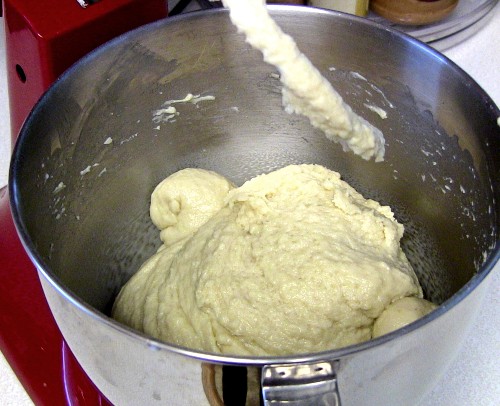
Step 3: Add eggs to the flour and mix in the warm milk, water and lard. Knead for 10 minutes. Let rise once until doubled in size. It helps to proof the dough in a slightly warm oven.

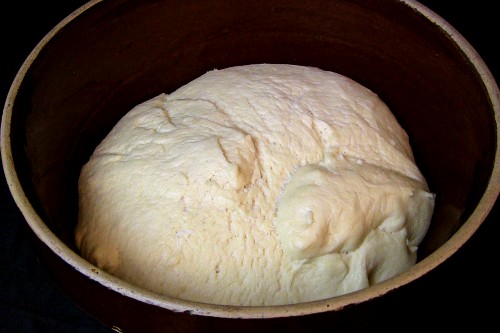
Step 4: Preheat oven to 375°F. Gently deflate the dough to get rid of some of the excess air without overworking it.
To shape, weigh out 71 gram (2.5 oz.) portions of dough and roll in the hands to form a ball. Place on a baking tray lined with a silicone mat or parchment paper and flatten until about four inches in diameter and 1/4 inch thick.


Pinch up the edges to form a ridge around the outside and create a well in the middle.
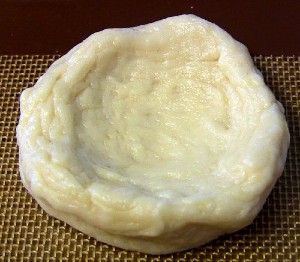
Step 5: Add about 2 tsp. pastry filling of any flavor to the center of the kolaches. It’s best if you can allow the pastries to rest and rise for about 20 minutes after shaping.
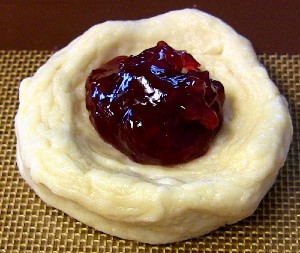
Step 6: Bake at 375°F. for 20 minutes, rotating the tray half-way through to ensure even baking.
(Brushing on a little melted butter right after they come out of the oven is a nice touch, even if Mrs. Cerny’s recipe doesn’t specifically call for it.)
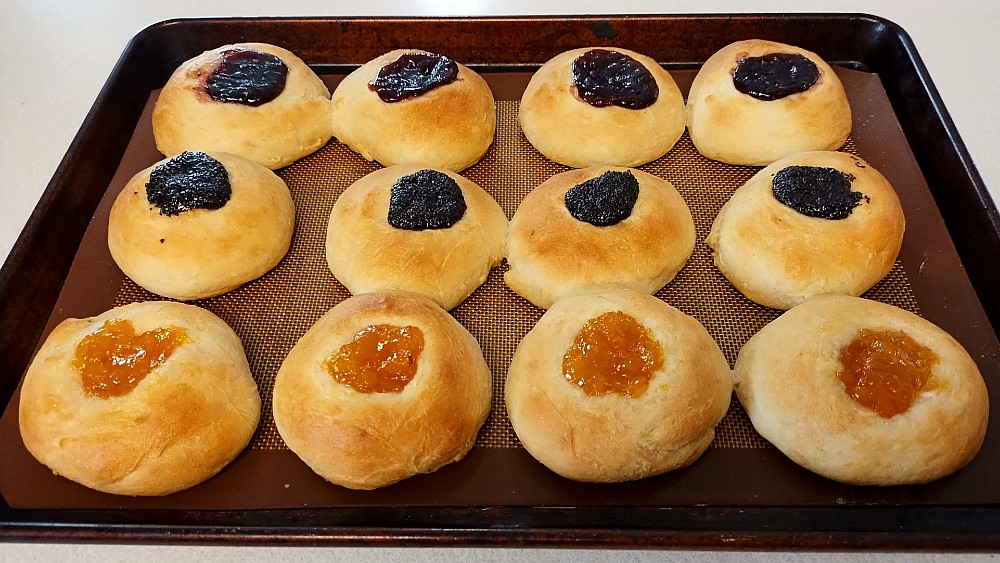

 Schmecken!
These look so very delicious! 🙂
LikeLiked by 2 people
Looks so good! Interesting recipes using lard instead of butter like a lot of other recipes do…Do people from Czech Republic use lard a lot? Sounds like the flavor gets rich👀✨
LikeLiked by 2 people
I think frugalness had as much to do with using lard as anything in the old days. It was inexpensive and could be stored for a long time. I do not think it has as much flavor as butter. It is lower in saturated fat than butter or vegetable shortening and people are showing new interest in it.
LikeLiked by 1 person
Oh ok! Well here in my neighbor I don’t know where to get lard (maybe meat section of counter? If I ask them they probably help me getting some) 🤔
LikeLiked by 1 person