
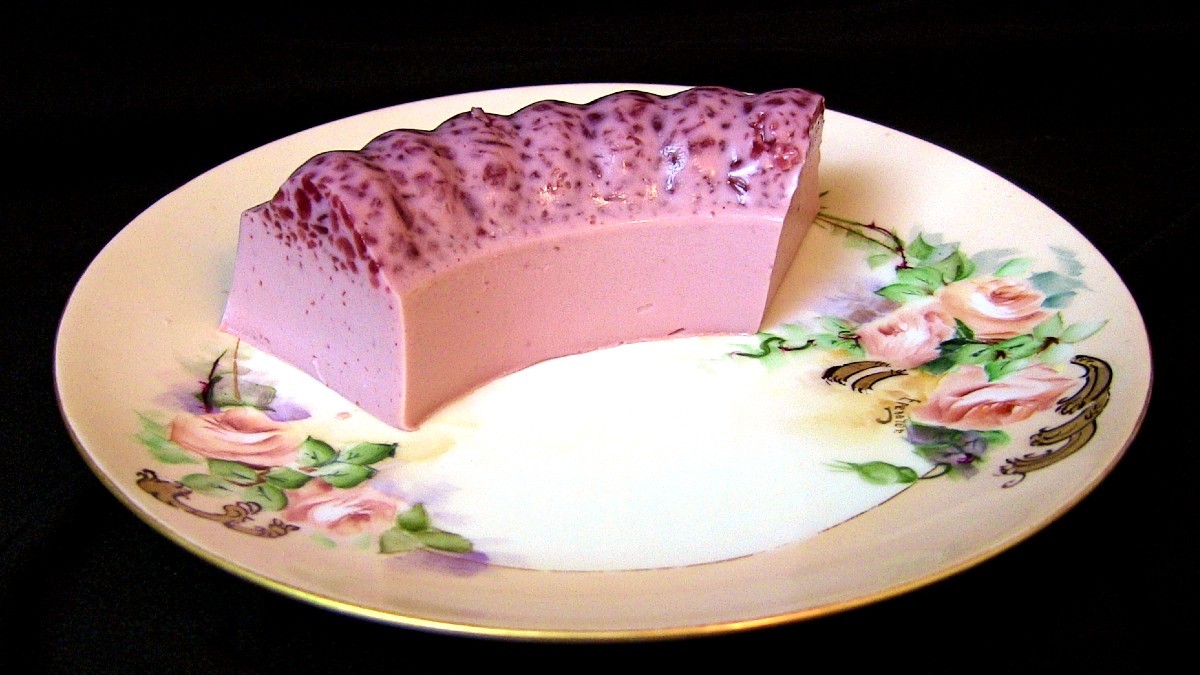
The inspiration for this recipe comes from a church cookbook of the early 1970s. It offers zingy tartness and solves the mystery of what to do with a can of jellied cranberry sauce.
Jellied cranberry sauce has always seemed as enigmatic to me as the monolith in Stanley Kubrick’s film 2001: A Space Odyssey.


People must have uses for jellied cranberry sauce or supermarkets wouldn’t sell it, but the stuff kind of freaks me out when it comes out of the can. I really do love this salad, though. It’s light and tangy and is quick to throw together with just a few ingredients.
Of course, the original recipe called for artificially-flavored and nuclear-colored Jello mix. This is completely unnecessary because unflavored gelatin and fruit juice work perfectly well. The original recipe also called for diced raw celery and chopped nuts. That just seems wrong.
Old church cookbooks, and mid-twentieth century recipes in general, are rife with combinations of ingredients that just seem wrong. There’s actually a historical reason for this that has its roots in the social reform movement of the late 1800s and early 1900s.
Many recipes originated in The Ladies’ Home Journal, which began in 1883 and was the first magazine to reach more than a million subscribers. The early editors of the magazine were social reformers who campaigned not only for healthy diets, but also for a woman’s right to vote, clean cities and towns, and wildlife conservation. The magazine was part of a national social reform movement that brought about great changes like the end to child labor, the eight-hour workday and mental health reform.
While it’s easy to make fun of some of the odd combinations of ingredients that grew out of The Ladies’ Home Journal tradition, it is important to realize that malnourishment was common and serving food that was nutritious was of primary importance. Maybe a few oddball ingredients got shoehorned into recipes where they didn’t really belong, but current “foodie” sensibilities would probably have seemed frivolous to people of an earlier age.
This post is part of a series in which I am attempting to reinvent recipes from old church cookbooks of the 1960s and ’70s from the Upper Midwest. The goal is to reduce the over-reliance on sugar and salt as the dominant flavor enhancers and cut down on the pre-packaged convenience foods that became so common as ingredients at that time. However, it wouldn’t be Midwestern cooking if practicality weren’t an important feature; I won’t be hand-harvesting my own salt or rendering my own artisanal lard.
Ingredients:
- 341 grams (1 ½) cups Water
- 114 grams (½ cup) Unsweetened Black Cherry Juice
- 18 grams (2 tbsp.) bulk Unflavored Gelatin 250 bloom OR 2 packets Knox Unflavored Gelatin OR 8 sheets Unflavored Gelatin
- 14 oz. can of Jellied Cranberry Sauce (Ocean Spray highly recommended)
- 227 grams (1 cup) sour cream
Directions:
Step 1: Break up the contents of a 14 oz. can of jellied cranberry sauce and microwave on high for one minute. Stir until the mixture is smooth. Allow to cool for several minutes and then fold in the sour cream. Mix well.
Step 2: Combine cold water and cold unsweetened cherry juice in a medium sauce pan. Sprinkle gelatin onto the liquid and whisk. Let sit for 2-3 minutes. Heat the mixture over medium-low heat until the gelatin is completely dissolved. Gelatin dissolves at about 100°F. Do not let boil. The gelatin will not set if it is brought to a boil.
Remove the juice from the heat and blend in the cranberry and sour cream mixture.
Step 3: Use a little non-stick spray to coat a mold that is at least 6 cups. Transfer the mixture to the mold and refrigerate until set. Times can vary with gelatin dishes but plan to give it at least six hours.

Step 4: After the gelatin is thoroughly set, use a spatula to gently pull away from the sides of the mold. Place a plate on top of the mold and flip. Allow the gelatin to drop from the mold naturally. Remember: gravity isn’t just a good idea, it’s the law.
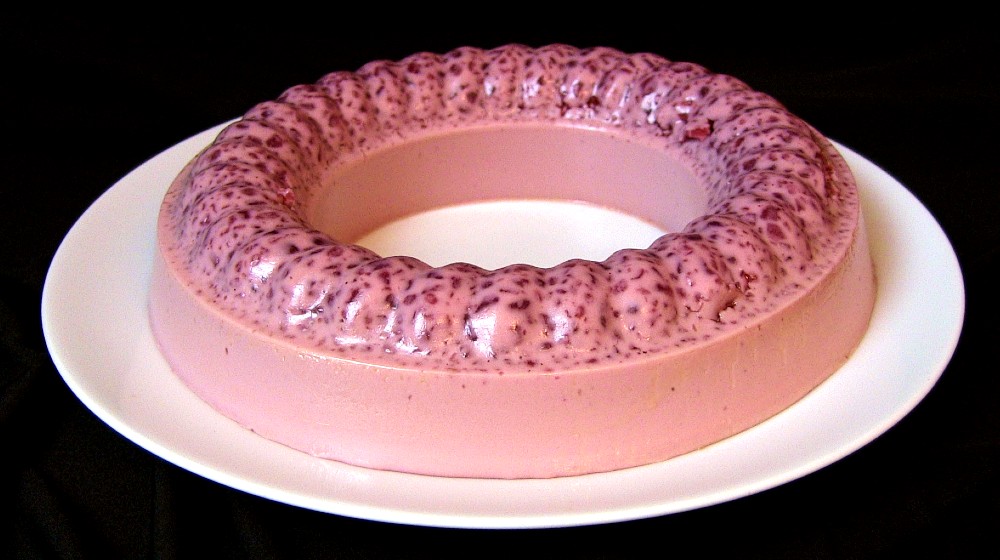

 Schmecken!
I think you’re lucky to have an access for cookbooks from old days because someone kept the book clean and saved it from going to a dump and passed to someone who is interested in classic recipe.
I also wonder…since I hear a lot of people say food today gets so much better in taste and nutrition, if we recreate the dish based on the exact same recipe (for this dish, including celery and nuts too!) do original book owner notice the difference or think the cook changed the recipe🤔
LikeLiked by 1 person
Many of the people who would have submitted recipes to cookbooks of the 1960s and ‘70s were from my parent’s generation and have passed away by now. I’m not sure there are many people left who would notice.
It’s easy to make fun of the foods that are found in these old cookbooks. I try to have a degree of understanding and compassion. After World War II, people thought that using convenience foods was the modern thing to do. It was the hippies in the 1960s that brought back the value of using natural ingredients. Styles change.
LikeLiked by 1 person
Ah exactly! Like fashion, food industry has a trend too👀💕 It must be an amazing thing that complete meal is ready in much shorter amount of time🤩
LikeLiked by 1 person