
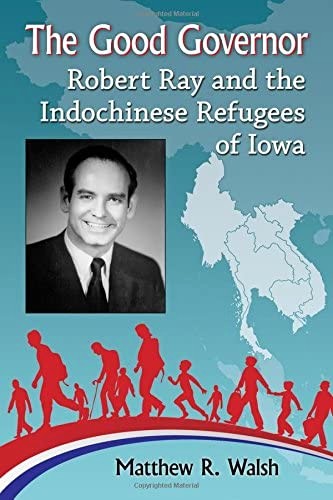
Iowa Public Television has produced a documentary on Robert D. Ray, who was governor of Iowa from 1969-1983. Robert Ray set an example of moral leadership among politicians that remains unique in my lifetime.
It’s a story I remember well. I was a sophomore in high school in 1979 when the Vietnamese and Cambodian Boat People Crisis happened. The images of families drowning as their flimsy crafts broke up in the ocean have stuck with me. I was glad to send in $30 of money I earned baling hay to Iowa Shares and seeing my name published in The Des Moines Register, along with all the many others who contributed.

A professor named Matthew R. Walsh has written an incredibly well-researched book called The Good Governor: Robert Ray and the Indochinese Refugees of Iowa about that history and I think it is a history worth telling often given the times we are living in now.
In 1975, Iowa Republican Governor Robert Ray responded to a humanitarian crisis with a profile in leadership. Ray enjoyed an 81% approval rating and parlayed the political capital he earned to come to the aid of the Tai Dam people, an ethnically distinct group who fled their homeland in Vietnam because of their opposition to the North Vietnamese Communist insurgency. Iowa has a unique place in the history of refugee services in the United States because of it, and from 1975-2010, Iowa was the only state recognized by the U.S. State Department as an official resettlement agency.
Following the fall of Saigon, President Gerald Ford asked the nation’s governors to take in refugees from Vietnam who had been allies of the U.S. and were now fleeing persecution. Iowa governor Robert Ray was the only one who said, “Yes.” Ray was motivated not only by his Christian values to help others in need, but also by his desire to gain more control over state government’s role in shaping refugee policy, and started an experiment that continues to influence resettlement policy to this day.
Ray was frustrated that state governors had so little control over refugee policy. The U.S. State Department allocated refugees to the states through voluntary agencies like Lutheran Services in Iowa and Catholic Charities who, understaffed and underfunded, often signed new refugees up for welfare as the quickest way to achieve stability for the newcomers. This placed a burden on state services and Ray believed it could set refugees up for long-term failure by creating a false impression about society’s expectations. Resorting to welfare as a first option fundamentally ran counter to his fiscal conservatism.
Ray placed administrative responsibility to resettle the Tai Dam under the Job Service of Iowa department. Previously, resettlement issues were administered through the state’s social services, the distributors of welfare. Colleen Shearer was the head of Job Service of Iowa and also acted as head of the Governor’s Task Force for Indochinese Resettlement, thus streamlining the effort to find the Tai Dam jobs as quickly as possible. Resettling the Tai Dam as a group made the job placement task easier because the state only had one language and set of cultural barriers to deal with; if one Tai Dam in a workplace spoke English, they could serve as interpreters for the other Tai Dam workers.
The cohesiveness of the Tai Dam people also contributed to the success of this experiment. Leaders within the Tai Dam community had negotiated for their people’s exodus from danger as a single group no less than four times since the early 1950’s. This strong sense of community meant that members helped one another in hard times and fit well with Ray’s goal of showing that his experiment could be successful in keeping refugees off welfare.
The Governor’s Task Force relied on three characteristics for success: work-first, cluster resettlement and individual sponsorship. Iowans across the state answered the call to sponsorship from the popular governor and signed up to provide individual attention to Tai Dam families. Not only did this provide an additional safety net for newcomers, it acted as the first point of integration into established society for refugees. In return, the refugees enriched the cultural landscape of Iowa permanently.
Nationally, the Iowa model gained attention because of the success of the Tai Dam people. Ray continued to push the envelope of his political capital. In response to the boat people crisis, Ray made an executive decision in January, 1979 to increase the intake of Indochinese refugees. He was one of two governors to attend the Special United Nations Conference on Refugees in Geneva, Switzerland that year in July.
At the conference, Vice President Walter Mondale electrified the crowd by referencing the failings of the international community in 1938 at Evian, France when 32 nations met to discuss the plight of the Jews. In his speech, Mondale said,
“Our children will deal harshly with us if we fail…Let us not be like the others. Let us renounce that legacy of shame. Let us reach beyond metaphor. Let us honor the moral principle we inherit. Let us do something meaningful – something profound – to stem this misery. We face a world problem. Let us fashion a world solution. History will not forgive us if we fail. History will not forget us if we succeed.”
Walter Mondale, Special United Nations Conference on Refugees, Geneva, Switzerland, 1979
Polling in Iowa showed that the majority of Iowans consistently opposed Ray’s resettlement policy. On December 4, 1979, conservative commentator Paul Harvey wrote an article that appeared nationwide in which he denounced what he called the refugees’ “parasitism” and “welfare-Cadillac” lifestyle. Harvey wrote that the Indochinese “buy and sell their teenage daughters; they skin and eat dogs and cats; they ravage our fishing grounds…Transporting them here is cruel to them and an affront to our own jobless.” He cautioned readers not to get suckered into donating to relief efforts by the emotionalized appeals pushed by bleeding-hearts, preachers, and fundraisers.
The nativist instinct of comments like these are an undeniable part of the character of the United States. It is a part of our past, our present and our future. People who have lived through ethnic violence know that this is the most tribal of instincts. The angry letters that were written to Iowa governor Robert Ray show that he knew this instinct as well.
Ray had choices to make as to how he would spend the political capital he earned through five terms as Iowa’s governor. Politicians have always faced criticism for issues relating to refugees and immigration and always will. It was Robert Ray’s personal moral choice as a leader to stand up to and rise above that criticism.

Des Moines Register File Photo

 Schmecken!