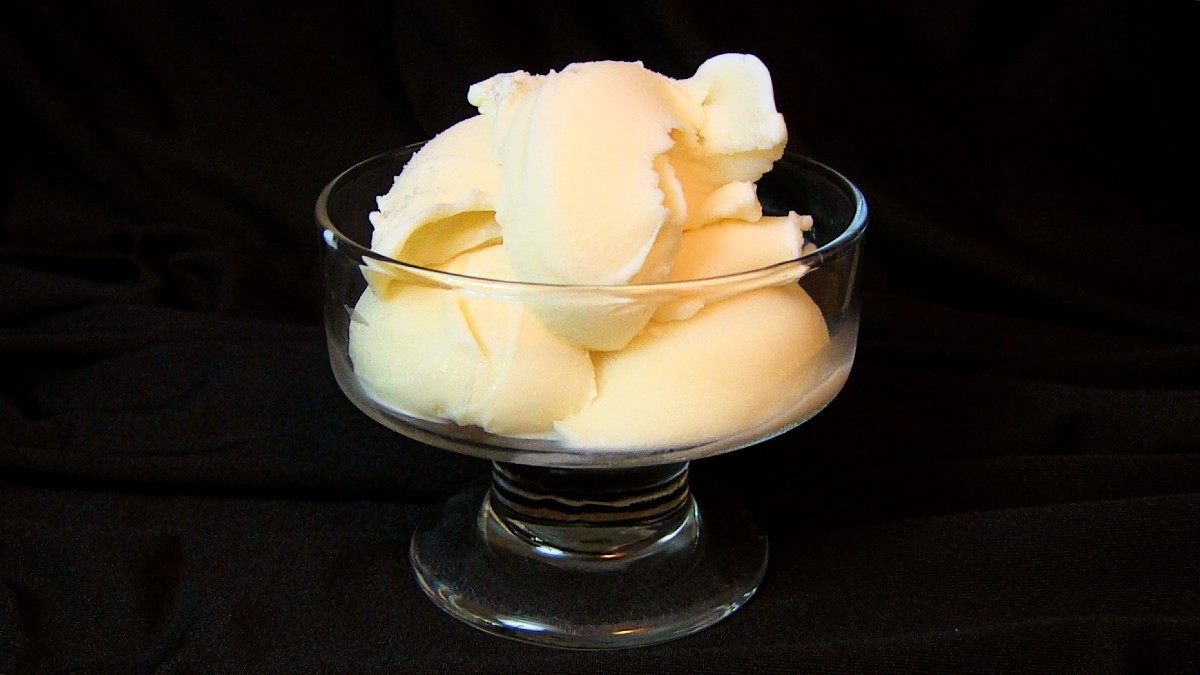
This is an ice cream that will defy all expectations. At first taste, it seems like a good vanilla ice cream…and then there’s horseradish! But the flavor doesn’t hit you in the face. It plays well with the other flavors of vanilla and orange. There’s a cleanness and freshness that I would never have guessed could be possible from anything with horseradish as an ingredient.
I came across this flavor combination on a TV contest show won by a British chef. At the time, I couldn’t find much of a recipe to go by, so I played around with a few batches to come up with something I liked. I was hopeful to find a good use for the horseradish I had planted because it took up so much space in the garden.
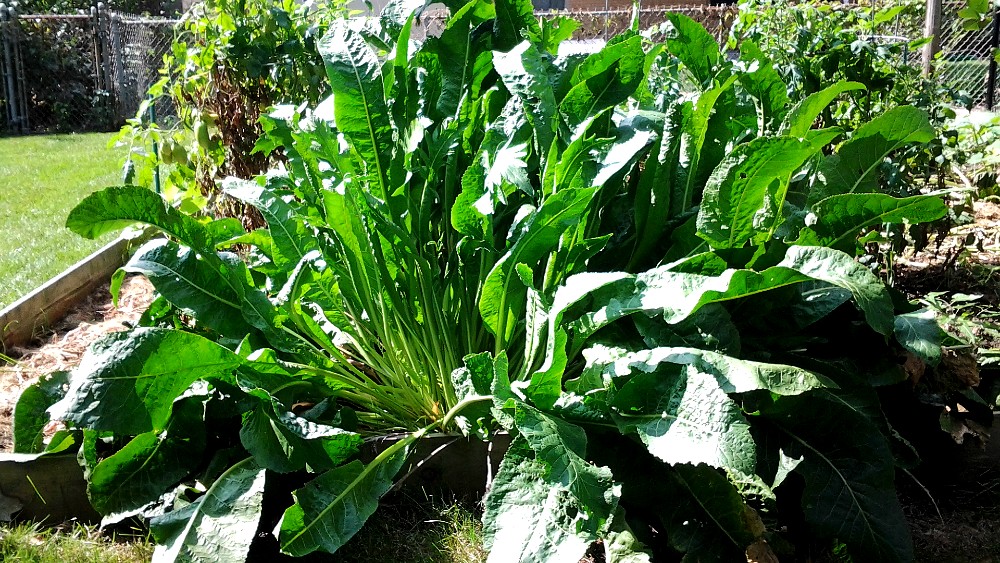
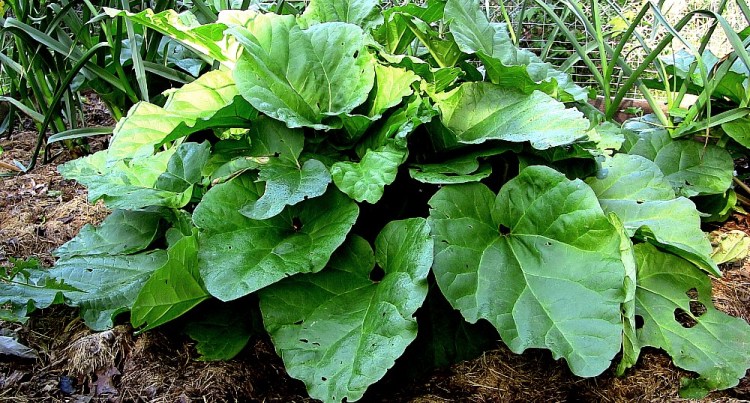
Horseradish Plant
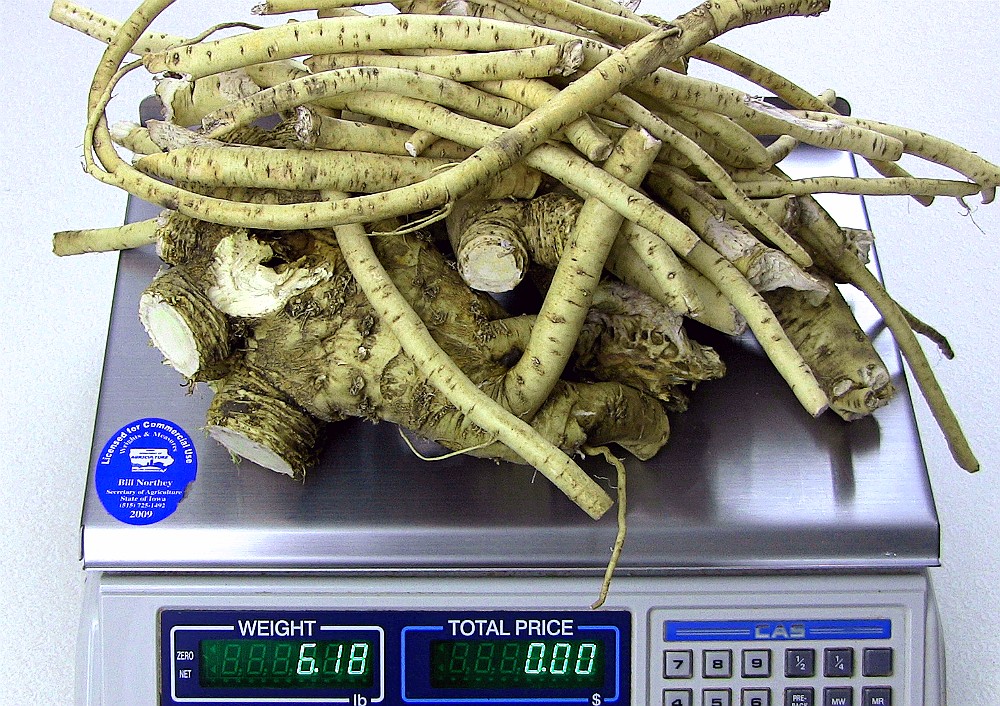
I dug up every bit that I could get to and harvested six pounds of horseradish root. It turns out that no matter how deeply you dig, you are unlikely to get all of it and this gigantic plant will just keep coming back year after year. Not even Roundup seems to phase it.
Six Pounds of Horseradish
There’s a sophistication to this flavor combination and it has a real “wow” factor. And not an “I-dare-you-to-eat-this” freak show kind of “wow” either. Using one ounce of fresh horseradish gives a subtle flavor and there may be room to be bolder. It’s a great dessert for a meal featuring beef.
Yield: 1 ½ quarts
Ingredients:
1 oz. fresh Horseradish Root, peeled and shredded (about ¼ cup)
2 cups Heavy Cream
2 cups Whole Milk
4 Egg Yolks
1 cup Sugar
1 cup Orange Juice, strained or pulp-free
¼ tsp. Salt
2 tsp. Vanilla Extract
Grated horseradish in vinegar IS NOT the same thing as fresh horseradish root. You can use a vegetable peeler to remove the rough, outer layer of horseradish root and a food processor will shred it just fine. You just need to do it outside or in an extremely well ventilated room because the fumes can take the top of your head off.
Directions:
Step 1: Peel and grate fresh horseradish root.
Step 2: Heat the heavy cream, milk and freshly grated horseradish root until simmering and remove from heat. Allow to steep for 10 – 20 minutes. Just like making tea, the longer it steeps, the stronger it tastes. Strain the mixture through cheesecloth to remove any solids.
Step 3: Whisk the sugar into the egg yolks to create a smooth consistency.
Step 4: Slowly add the hot milk mixture to the egg mixture a little at a time while stirring constantly. You do not want the eggs to cook from milk that is too hot.
Step 5: Mix in orange juice, salt, and vanilla extract.
Step 6: Return the mixture to the stove and heat up to 160° F. This is very important because of food safety issues involving raw eggs.
Step 7: Cool thoroughly in the refrigerator.
Step 8: Churn in your ice cream maker according to the manufacturer’s instructions.
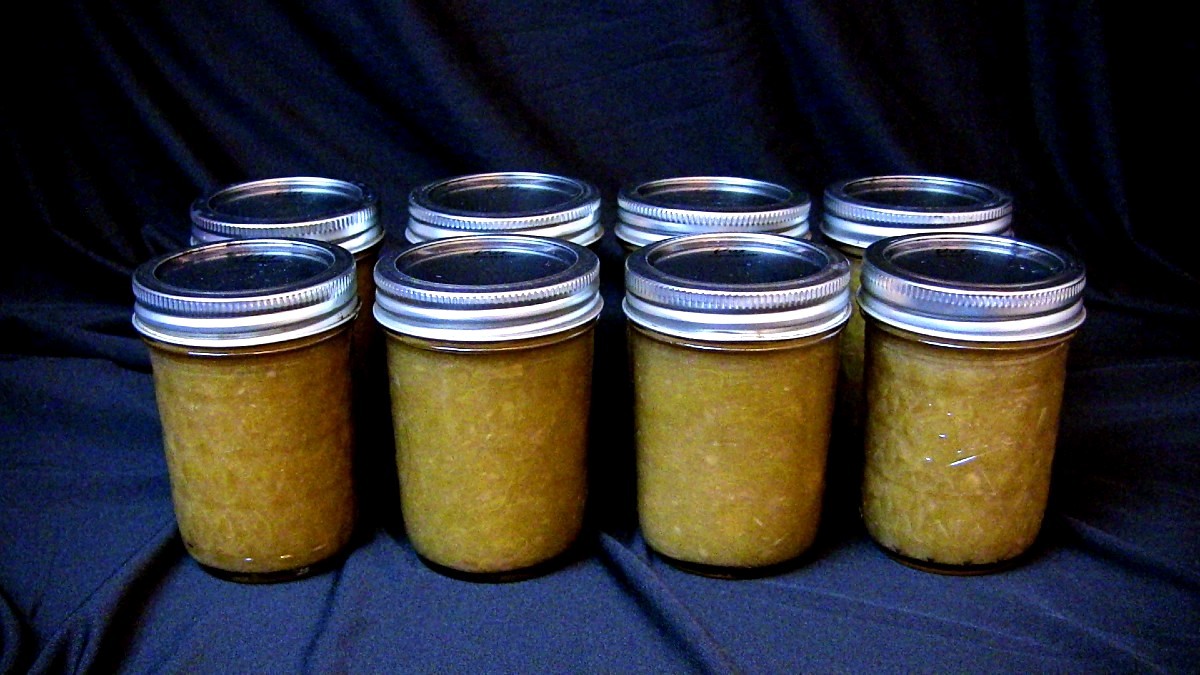
Rhubarb production is well underway by May in the Zone 5 growing region and it’s a great idea to preserve the flavor of spring to get a reminder of that time during the cold winter months. The flavor of homemade preserves spread on warm, fresh-baked bread brightens the senses during the darker months and boosts one’s optimism for the future.
Victoria Rhubarb
The basis for my recipe comes from a recipe that won a rhubarb contest on The Huffington Post. I’ve boosted the ginger content quite a bit and freely admit to using jarred ginger purée as a labor-saver instead of peeling fresh ginger. One should definitely taste-as-you-go when making this to get the flavor combo just right for you.
Yield: Eight 8-ounce Jars
Ingredients:
3 lbs. Rhubarb, cut into ½-inch pieces
594 grams (3 cups) Granulated White Sugar
¼ cup Crystallized Ginger
10 oz. puréed Fresh Ginger
Directions:
Combine the rhubarb, ginger and sugar in a large saucepan. Stir over medium heat until the sugar dissolves and the mixture begins to bubble. Continue to simmer, while stirring frequently, until the jam thickens to your preference. This may only take 10-20 minutes. The fiber content of rhubarb is great for making sturdy jams.
Ladle the mixture into hot, sterilized 8-ounce jam jars leaving about 1/4-inch of space between the jam and rim of the jar. Cover with lids and rings and process the jars for 10 minutes in a hot water bath. For anyone new to canning, it’s good to become acquainted with the USDA Complete Guide to Home Canning.
It’s good to have a vegetarian dish that meat-eaters will love too, and this one benefits from being extremely inexpensive to make.
I once had to make a main dish for a potluck held to benefit about 35 – 40 refugee women, mostly from Central Africa and Bhutan, who had a variety of religious dietary restrictions. It was wintertime so I wanted the food to be hot. I wanted it to be hearty and nutritious. It needed to be inexpensive because it was for a non-profit. The dish also needed to be easy to make because of the large quantity of food required to feed that many people.
I thought a vegetarian shepherd’s pie would be a good way to go. I found an excellent recipe that would fit a two-quart baking dish that used lentils, barley and Vegemite as the meat substitute. There was a vegetable portion to the recipe that was made from scratch and mashed potatoes made from scratch also. I needed to size-up the quantity massively and also find a way to get out of doing so much prep work on the vegetables and mashed potatoes.
I decided to use the most inexpensive form of frozen mixed vegetables I could buy and to use boxed instant mashed potatoes. Frozen vegetables are actually very nutritious. Instant mashed potatoes are simply dehydrated potatoes; there’s nothing all that weird about them.
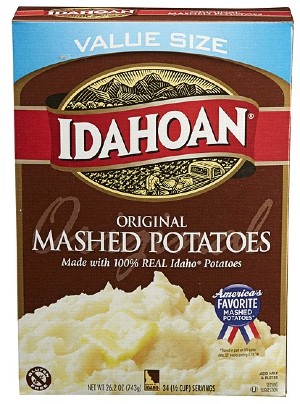
The most inexpensive form of frozen mixed vegetables are combinations of carrots, corn, peas, green beans and lima beans. Online reviews of instant mashed potatoes overwhelmingly praised Idahoan Original Instant Mashed Potatoes as being the best.
Idahoan Original Instant Mashed Potatoes
Testing in small batches revealed several points:
The vegetables needed to be steamed first in order to cook out the rawness.
Each layer needed to be well-seasoned.
Lots of butter needed to be used in the vegetable and potato layers. It was especially important to have an ample amount of fat to keep the leftovers from being completely dried out when reheated.
I layered everything in an 18-quart electric roaster oven and was able to feed over 35 people for a little under $30 by getting the mixed vegetables on sale. The dish was a big hit and people took home leftovers.
I’ll probably never make a batch that size again so, in order to enjoy this at home, I needed to reverse engineer the recipe back down to a reasonable size. This recipe fills a two-quart baking dish nicely.
Directions:
Faux “Meat” Layer:
½ cup Dry Lentils
⅓ cup Pearled Barley
2 ½ cups Vegetable Stock
2 tsp. Vegemite or Marmite
Combine 2 ½ cups vegetable stock, 2 tsp. Vegemite or Marmite, ½ cup dry lentils and ⅓ cup pearled barley and simmer until the lentils and barley are cooked until tender and the liquid is absorbed, about 20 minutes. Layer onto the bottom of a two-quart baking dish.
Lentils and Barley Layer
Vegetable Layer:
12 oz. frozen Mixed Vegetables (carrots, corn, peas, green beans and lima beans)
2 tbsp. Butter
½ tsp. Sea Salt
1 tsp. Ground Black Pepper
½ tsp. Granulated Garlic
Thaw the mixed vegetables, bring water to a boil and steam for about 5 – 7 minutes. You don’t want them to turn to mush, but you want to cook out some of the raw flavor. Melt 2 tablespoons of butter in the vegetables and add ½ teaspoon sea salt, 1 teaspoon ground black pepper, and ½ teaspoon granulated garlic. Layer on top of the lentils and barley.
Vegetable Layer
Mashed Potato Layer:
1 ⅓ cups Idahoan Original Instant Mashed Potatoes
1 ⅓ cups Water
⅔ cup Milk (⅓ cup milk and ⅓ Half n’ Half is a nice combo)
5 tbsp. Butter
½ tsp. Sea Salt
1 tsp, Ground Black Pepper
½ tsp. Granulated Garlic
Topping for Mashed Potatoes:
1 tbsp. Butter, melted
Combine 1 ⅓ cups water, ½ tsp. sea salt, 1 tsp. ground black pepper, ½ tsp. granulated garlic and 5 tbsp. butter and bring to a boil. Remove from heat.
Add ⅔ cup cold milk; stir in 1 ⅓ cups Idahoan Original Instant Mashed Potatoes gently and let stand until moist. Layer on top of the vegetables and run a fork over the top of the mashed potatoes to create ridges throughout. The ridges make lovely browned bits when baked. Drizzle 1 tbsp. of melted butter over the mashed potato layer.
Bake in an oven that has been preheated to 350° F. for 30 minutes. Switch the oven to the broiler setting and bake until the top is browned, about 5 minutes.
Notes:
Vegemite was developed in Australia as a response to shortages of Marmite from England during World War One. Marmite had been for sale in England since 1902 and, love it or hate it, Marmite was a nutrient-dense food that had an extremely long shelf-life at a time when malnutrition was common. Wartime only made the need for Marmite and Vegemite more important.
The process for making it was developed by German scientist Justus von Liebig in the late 1800s from the yeast that was leftover from brewing beer. It’s packed with umami flavor and is a potent vegan source of B vitamins and minerals. Marmite and Vegemite were included in rations for soldiers because it helped combat outbreaks of beriberi and other deficiency diseases.
Because of the link to Australia, I am throwing in a memorial to the person who had my all-time favorite singing voice, Judith Durham, who was a member of the Australian folk music group, The Seekers, and who passed away in 2022. She possessed an extraordinary voice which she maintained like a fine Stradivarius until late in life. This clip is a great example of their sound. I love how the guys are wearing suits and skinny ties and have such earnest expressions on their faces.
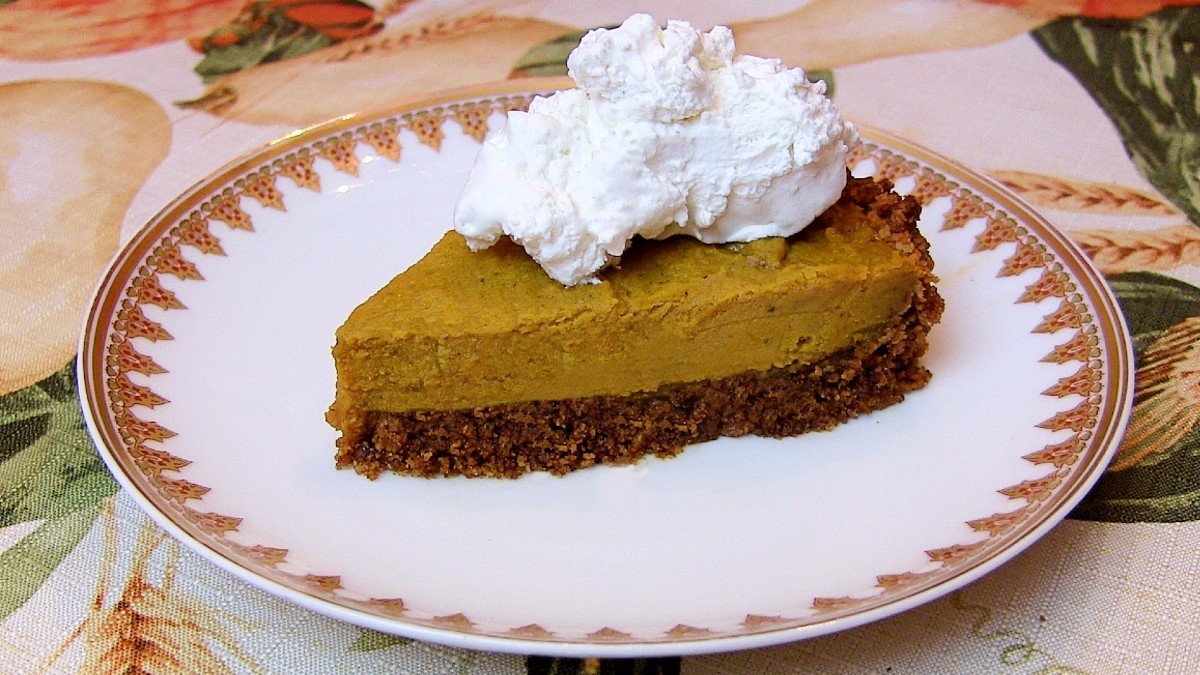
I set out to make a pumpkin pie from scratch with the goal of letting the true character of the pumpkin come through without overwhelming the flavor with sugar and spices. I also wanted to try spices other than traditional pumpkin pie and drew inspiration from an Indian dessert called Halwa, which is also made from pumpkin and features cardamom. I’ve used ghee and jaggery in order to stick with the Indian inspiration, however, butter and brown sugar will work perfectly well.
The result is still a traditional pumpkin pie but with a light hint of cardamom that allows the real flavor of the pumpkin to show through. A little black pepper provides structure without drawing attention to itself and the ghee is decadent.
Jarrahdale Pumpkin
A farmer who runs a local pumpkin stand told me his favorite one for cooking is the Jarrahdale Pumpkin. He also said he prefers a graham cracker crust so I followed his suggestions.
The Jarrahdale pumpkin has a very tough shell and I had to use a large, sturdy knife to cut it into quarters and then remove the seeds. The quarters were baked on a rimmed tray with water in the bottom for about an hour and 20 minutes at 400°F. The pumpkin was 10-15 lbs. to start with and yielded 6½ lbs. of cooked pulp. I use 15 oz. of cooked pumpkin for a pie since most recipes are geared to use 15 oz. cans of pumpkin puree.
You may be able to find Jarrahdale Pumpkins for sale at a deep discount after Halloween. A 10-15 lbs. pumpkin may be on sale for as low as $2.50. That’s a lot of versatile, quality food for not much money.
I thought the rich custard of pumpkin pie might benefit from something tart to cut through, so I use lime whipped cream as a topping. The tartness of the topping makes for a great counterpoint to the pumpkin.
Directions:
Pie Crust
1 ½ cups Graham Cracker Crumbs (12 full-size Original Nabisco Graham Crackers, crushed into crumbs)
2 tbsp. Jaggery Powder or Brown Sugar
6 tbsp. Ghee or Butter, melted
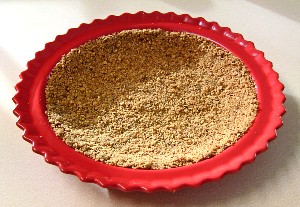
Preheat the oven to 350°F. Mix the ingredients and form a crust in a nine-inch pie pan. Use the bottom of a glass or mixing cup to tamp down the cracker mix to provide some solid structure. Bake the empty crust for seven minutes and allow to cool.
Graham Cracker Crust
Pie Filling
15 oz. Jarrahdale Pumpkin, cooked
3 Large Eggs
1 cup Heavy Cream
¼ cup Whole or 2% Milk
1 tbsp. Corn Starch
6 tbsp. Jaggery Powder or Brown Sugar
1 tsp. Sea Salt
½ tsp. Ground Cardamom
½ tsp. Ground Black Pepper
Purée the cooked pumpkin until smooth. Combine the ingredients in a saucepan. Slowly heat the mixture while stirring constantly in order to avoid scrambling the eggs. Heat to bubbling and continue stirring for about two minutes until it thickens to a pudding-like consistency. Pour the mixture onto the pie crust and bake for 30 minutes. Allow to cool thoroughly. Serve with a dollop of lime whipped cream.
Lime Whipped Cream
1 cup Heavy Cream, chilled
½ tsp. Pure Vanilla Extract
Zest of 1 Lime
Juice of 1 Lime
2 tbsp. Powdered Sugar
Combine all the ingredients into a chilled bowl. Use a mixer to whisk the ingredients until soft peaks form.
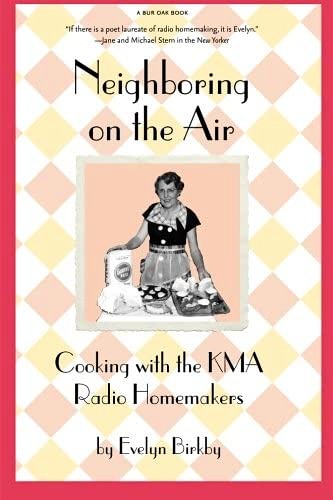
The Everly Brothers began their Hall of Fame careers playing music while young boys on KMA Radio in Shenandoah, Iowa on the Everly Family Show with their father, Ike, and mother, Margaret, in the 1940s. Many years later, Margaret Everly submitted family-favorite recipes to a book that told the story of KMA Radio and the radio homemakers who shared recipes and household management tips to a large midwestern audience. The program, “Kitchen Klatter,” became the longest-running homemaker program in the history of radio. Iowa Public Television made a documentary based on the book, “Neighboring on the Air: Cooking with the KMA Radio Homemakers” by Evelyn Birkby, which includes favorite recipes from the Everly family.
Neighboring on the Air: Cooking with the KMA Radio Homemakers, by Evelyn Birkby
Ike Everly began working in the coal mines of Muhlenberg County, Kentucky when he was 14 years old. Ike had a talent for music and helped develop a three-finger guitar playing style that was unique to Muhlenberg County and has since been imitated far and wide. He’s now considered to be one of the most influential guitar players of the 20th century. (See Notes after the recipe) He began playing locally in Kentucky and eventually made his way to Chicago where he gained experience in nightclubs and radio.
Margaret grew up three houses away from Ike in Brownie, Kentucky and married Ike when she was 15 years old and Ike was 26. They knew they didn’t want to raise a family in Chicago and made their way west to Waterloo, Iowa. Seeking a smaller town to raise their children, they heard of the radio station in Shenandoah, Iowa that employed musicians for their broadcasts. Ike contacted the station manager of KMA Radio and secured a job.
Starting in 1945, the Everly’s spent eight years performing on KMA Radio. Phil and Don were six and eight years old when they began making appearances on KMA Radio. A few years later, the whole family began performing live on the Everly Family Show which aired at 5:30 in the morning. According to the book, “KMA Radio: The First 60 Years,” by Robert Birkby, Margaret Everly recalled:
“Early in the morning Ike would go out to start the car to get it warm while I made hot chocolate for the boys. In the winter it might be sixteen below zero outside, but we never missed a show. I think we would have crawled to the studio to put that show on.”
In addition to performing on the radio, Don and Phil were active in school, had paper routes and lemonade stands, and detasseled corn in the summers. Shenandoah, Iowa was a great place to grow up but, unfortunately, by the early 1950s radio stations moved away from employing full-time musicians and the Everly’s had to move on.
They made their way to Tennessee in 1953 and performed on small radio stations where they came to the attention of Chet Atkins. With help from Atkins, the Everly Brothers signed with Cadence Records and in February, 1957, they recorded “Bye, Bye Love” which shot up to No. 2 on the pop charts behind Elvis Presley’s “Teddy Bear.” It became their first of many million-selling records.
The Everly Brothers performing “Bye, Bye Love” on an unknown television show.
The importance of radio to rural America cannot be overstated and the history of KMA Radio is a fascinating one. Margaret Everly included recipes for fried chicken and fried oysters in the book commemorating the homemakers of KMA Radio, but I’ve decided to highlight the recipe she submitted as Phil Everly’s favorite dessert.
This recipe makes a LOT of custard and I would cut way back when making it again. I’d also use more vanilla extract and go with a thicker graham cracker crust. However, the goal was to try and recreate this as accurately as possible. I’ve made a slight alteration from the original recipe by increasing the amount of egg whites used in the meringue to adequately cover the whole dish. I’ve also simplified the cooking instructions somewhat.
Directions:
Crust
140 grams (1 package or 9 cracker sheets) Original Nabisco Graham Crackers, crushed into crumbs for the base
48 grams (3 cracker sheets) Original Nabisco Graham Crackers, crushed into crumbs for topping
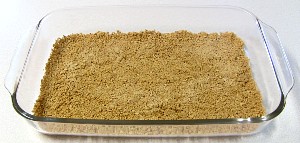
Crush one package of graham crackers into crumbs and form a crust in the bottom of a standard 13 x 9 x 2 inch baking dish. Crush an additional three sheets of graham crackers and reserve for a topping.
Graham Cracker Crust
Filling
248 grams (1 ¼ cups) Granulated White Sugar
30 grams (¼ cup) All-Purpose Flour
2 tbsp. Cornstarch
3 ½ cups Milk
2 Egg Yolks, lightly beaten
2 tbsp. Butter, melted
1 tsp. Pure Vanilla Extract
4 to 5 Bananas, sliced
Combine sugar, flour and corn starch, then mix in the beaten egg yolks. Add milk and mix thoroughly. Slowly heat the mixture while stirring constantly in order to avoid scrambling the egg yolks. Heat to bubbling and continue stirring for about two to three minutes until it thickens enough to coat the back of a spoon. Remove from heat, add melted butter and vanilla and allow to cool somewhat. It should take on a pudding-like consistency fairly quick.
Meringue
4 Egg Whites
4 tbsp. Granulated White Sugar
¼ tsp. Cream of Tartar
Beat the egg whites until foamy, then gradually add the sugar and cream of tartar. Continue until you have stiff peaks.
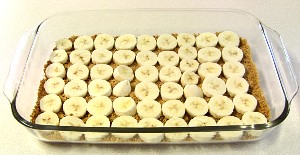
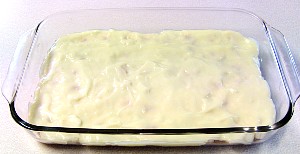
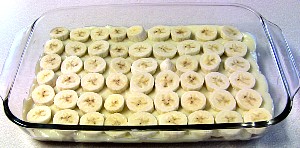
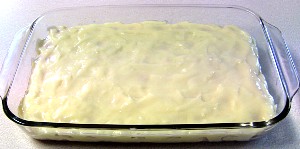
Preheat the oven to 350°F. Arrange enough banana slices to cover the graham cracker crust. Spread on half the custard. Repeat with another layer of bananas and the rest of the custard. Sprinkle the custard with the reserved graham cracker crumbs.
First Layer of Bananas
First Layer of Custard
Second Layer of Bananas
Second Layer of Custard
Graham Cracker Topping
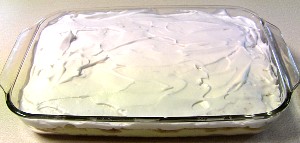
Spread on the meringue and bake for about 15 minutes until light brown on top. Let cool on a wire rack.
Meringue Topping
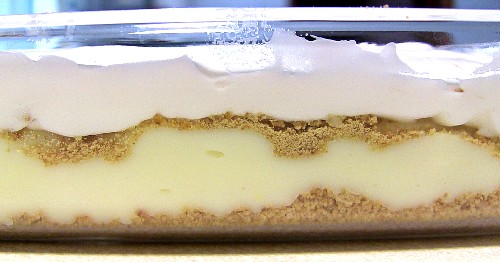
Cross Section Side View
Final Bake
Notes:
I first thought that doing a post about a recipe from one of the Everly Brothers was, on the face of it, just kind of quirky and funny. As I dug into the story a little bit, it took me down a path I hadn’t seen coming.
I grew upon a farm in Iowa and have always had an interest in history, yet my knowledge of the Everly Brother’s connection to Iowa history did not extend much beyond what is the standard Chamber of Commerce template version of all local history in Iowa:
“Come to [name of town] – Boyhood Home of [famous person] – and while you’re here enjoy our many shopping opportunities.”
What was a revelation to me when I started doing research was the little-noticed importance of Ike Everly’s place in the history of American music. He never hit the big time, but he ranks alongside such giants of American Folk Music as Doc Watson and Merle Travis.
Ike Everly was one of four people, along with Arnold Schultz, Kennedy Jones and Mose Rager, who were largely responsible for developing a three-finger guitar playing style that Everly and Rager taught to fellow-neighbor, Merle Travis, while working in the coal fields. Merle Travis went on to become a giant in American music. He wrote the song, “Sixteen Tons,” that was on an album of coal mining songs he made and his guitar playing influenced Chet Atkins, who was largely responsible for the Everly Brothers getting their first big break.
The playing style Ike Everly helped develop influenced countless musicians during the Folk Music Revival of the 1950s and ’60s. Johnny Cash called him one of the most influential guitar players of the 20th Century.
I came across an article ranking 10 Great Musical Moments from the Newport Folk Festival Since 1959 and his performance with his sons, Don and Phil, in 1969 comes in at No. 5 on the list. For some perspective, Bob Dylan’s famous “going electric” performance ranks as No. 3.
What first got my attention was the fact that he was from Muhlenberg County, Kentucky. It immediately brought to mind the John Prine song, “Paradise” and the verse:
Daddy, won't you take me back to Muhlenberg County
down by the Green River
where Paradise lives.
Well, I'm sorry my son
but you're too late in askin'
Mr. Peabody's coal train has hauled it away.
The song is based on the true story of Paradise, Kentucky, a town that was literally scraped out of existence by coal mining.
Ike Everly started working in the coal mines when he was 14 years old and it was Black Lung Disease that claimed him in the end. But he had talent, and his talent allowed him to escape the bone-punishing grind of coal mining and give his family a chance at a better life.
Ike Everly quite possibly could have achieved greater fame and fortune for himself had he stayed performing on radio in Chicago as Merle Travis had done in Cincinnati. However, the biggest priority for Ike and Margaret Everly was to find a nice small town where they could raise their children.
Margaret Everly alluded to their life in Shenandoah, Iowa as having been an idyllic time and that they may never have left had the changes in the radio industry not necessitated their move. She outlived both her sons and passed away in 2021 at the age of 102. She spoke highly of their time in Shenandoah, Iowa to her grandchildren until the end of her life.
I find the story of Ike and Margaret Everly to be quite moving and poignant. I’m not the only person with a rural background who’s experienced a sense of loss at realizing that one can’t go home again because the old place doesn’t really exist anymore.
Some of my interest in old recipes is an attempt to capture a bit of what that old aura was like and to keep a little sense of it going.
There’s some old clips from The Johnny Cash Show that have Ike Everly playing his unique guitar style. The clips are a little ragged, but worth watching if you’re into Americana music.
Ike Everly Joined by Mabelle Carter In a Guitar Instrumental
The Everly Brothers / Ike Everly / Tommy Cash on the Johnny Cash Show
This is an hour-long set of Ike Everly with his sons, Don and Phil, at the Newport Folk Festival from 1969.
Everly Brothers International Archive : Live at the Newport Folk Festival – Workshop (July 18,1969)
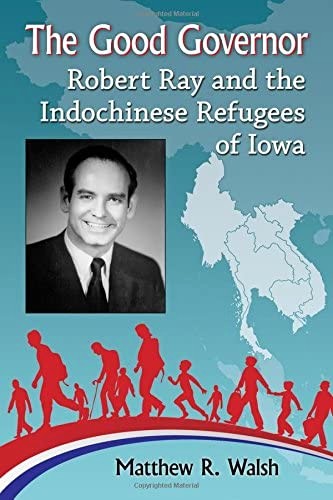
Iowa Public Television has produced a documentary on Robert D. Ray, who was governor of Iowa from 1969-1983. Robert Ray set an example of moral leadership among politicians that remains unique in my lifetime.
It’s a story I remember well. I was a sophomore in high school in 1979 when the Vietnamese and Cambodian Boat People Crisis happened. The images of families drowning as their flimsy crafts broke up in the ocean have stuck with me. I was glad to send in $30 of money I earned baling hay to Iowa Shares and seeing my name published in The Des Moines Register, along with all the many others who contributed.
In 1975, Iowa Republican Governor Robert Ray responded to a humanitarian crisis with a profile in leadership. Ray enjoyed an 81% approval rating and parlayed the political capital he earned to come to the aid of the Tai Dam people, an ethnically distinct group who fled their homeland in Vietnam because of their opposition to the North Vietnamese Communist insurgency. Iowa has a unique place in the history of refugee services in the United States because of it, and from 1975-2010, Iowa was the only state recognized by the U.S. State Department as an official resettlement agency.
Following the fall of Saigon, President Gerald Ford asked the nation’s governors to take in refugees from Vietnam who had been allies of the U.S. and were now fleeing persecution. Iowa governor Robert Ray was the only one who said, “Yes.” Ray was motivated not only by his Christian values to help others in need, but also by his desire to gain more control over state government’s role in shaping refugee policy, and started an experiment that continues to influence resettlement policy to this day.
Ray was frustrated that state governors had so little control over refugee policy. The U.S. State Department allocated refugees to the states through voluntary agencies like Lutheran Services in Iowa and Catholic Charities who, understaffed and underfunded, often signed new refugees up for welfare as the quickest way to achieve stability for the newcomers. This placed a burden on state services and Ray believed it could set refugees up for long-term failure by creating a false impression about society’s expectations. Resorting to welfare as a first option fundamentally ran counter to his fiscal conservatism.
Ray placed administrative responsibility to resettle the Tai Dam under the Job Service of Iowa department. Previously, resettlement issues were administered through the state’s social services, the distributors of welfare. Colleen Shearer was the head of Job Service of Iowa and also acted as head of the Governor’s Task Force for Indochinese Resettlement, thus streamlining the effort to find the Tai Dam jobs as quickly as possible. Resettling the Tai Dam as a group made the job placement task easier because the state only had one language and set of cultural barriers to deal with; if one Tai Dam in a workplace spoke English, they could serve as interpreters for the other Tai Dam workers.
The cohesiveness of the Tai Dam people also contributed to the success of this experiment. Leaders within the Tai Dam community had negotiated for their people’s exodus from danger as a single group no less than four times since the early 1950’s. This strong sense of community meant that members helped one another in hard times and fit well with Ray’s goal of showing that his experiment could be successful in keeping refugees off welfare.
The Governor’s Task Force relied on three characteristics for success: work-first, cluster resettlement and individual sponsorship. Iowans across the state answered the call to sponsorship from the popular governor and signed up to provide individual attention to Tai Dam families. Not only did this provide an additional safety net for newcomers, it acted as the first point of integration into established society for refugees. In return, the refugees enriched the cultural landscape of Iowa permanently.
Nationally, the Iowa model gained attention because of the success of the Tai Dam people. Ray continued to push the envelope of his political capital. In response to the boat people crisis, Ray made an executive decision in January, 1979 to increase the intake of Indochinese refugees. He was one of two governors to attend the Special United Nations Conference on Refugees in Geneva, Switzerland that year in July.
At the conference, Vice President Walter Mondale electrified the crowd by referencing the failings of the international community in 1938 at Evian, France when 32 nations met to discuss the plight of the Jews. In his speech, Mondale said,
“Our children will deal harshly with us if we fail…Let us not be like the others. Let us renounce that legacy of shame. Let us reach beyond metaphor. Let us honor the moral principle we inherit. Let us do something meaningful – something profound – to stem this misery. We face a world problem. Let us fashion a world solution. History will not forgive us if we fail. History will not forget us if we succeed.”
Walter Mondale, Special United Nations Conference on Refugees, Geneva, Switzerland, 1979
Polling in Iowa showed that the majority of Iowans consistently opposed Ray’s resettlement policy. On December 4, 1979, conservative commentator Paul Harvey wrote an article that appeared nationwide in which he denounced what he called the refugees’ “parasitism” and “welfare-Cadillac” lifestyle. Harvey wrote that the Indochinese “buy and sell their teenage daughters; they skin and eat dogs and cats; they ravage our fishing grounds…Transporting them here is cruel to them and an affront to our own jobless.” He cautioned readers not to get suckered into donating to relief efforts by the emotionalized appeals pushed by bleeding-hearts, preachers, and fundraisers.
The nativist instinct of comments like these are an undeniable part of the character of the United States. It is a part of our past, our present and our future. People who have lived through ethnic violence know that this is the most tribal of instincts. The angry letters that were written to Iowa governor Robert Ray show that he knew this instinct as well.
Ray had choices to make as to how he would spend the political capital he earned through five terms as Iowa’s governor. Politicians have always faced criticism for issues relating to refugees and immigration and always will. It was Robert Ray’s personal moral choice as a leader to stand up to and rise above that criticism.
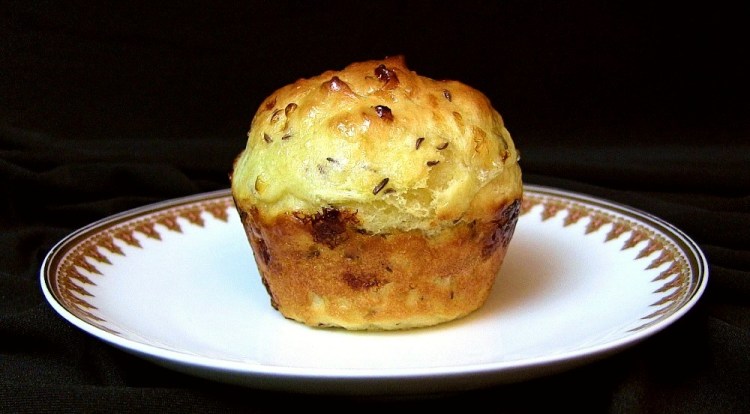
Caraway Puffs were a favorite of the father of my partner Debra and she has strong memories of both her parents in the kitchen making them. The recipe stayed in a box for many years after they passed away. The first time we made them again she said:
“As soon as the caraway hit the warm cottage cheese, the aroma took me back to being five years old again – being with my parents in the kitchen.“
The aromas of food can trigger profoundly vivid memories. Scents bypass a lot of the brain’s hardware and go straight to the olfactory center, which is directly connected to the amygdala and hippocampus, which deal with emotion and memory. It’s why, all of a sudden, a slight scent can make the distance to a long-ago time and place disappear for a moment – a moment during which the forward motion of time seems to stop and hang in the air. In fact, it’s as though the past exists parallel to the present and can be touched just by reaching out. These moments of time travel themselves can become special memories.
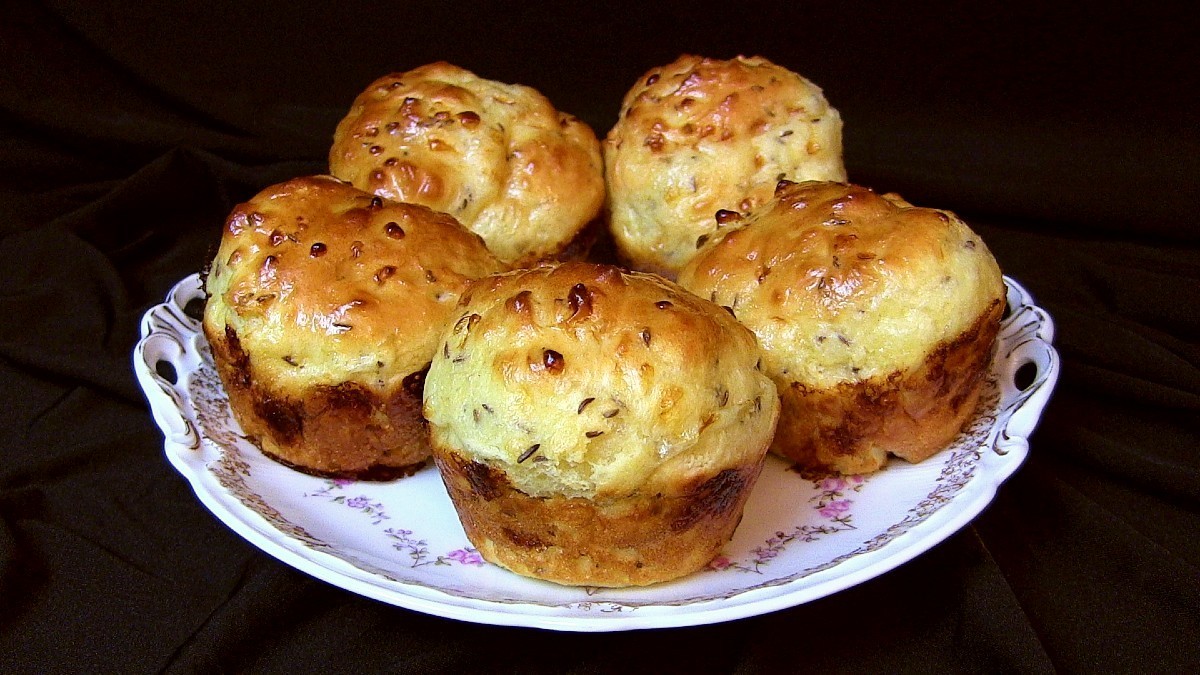
These pillowy-soft muffins feature cottage cheese as a key ingredient. They’re light as a feather and puffy as a cloud. They’re a bit of a cross between a roll and a muffin; they feature both yeast and baking soda for rising. They’re baked in a muffin tin because the mix is more of a batter than a firm dough. They stay moist for days but chances are they won’t last that long.
Yield : 12 Caraway Puffs
Ingredients:
114 grams (½ cup) Water, lukewarm
4 tsp. (2 pkgs.) Instant Dry Yeast
16 oz. (2 cups) Cottage Cheese, small curd
50 grams (¼ cup) Sugar
2 tsp. Sea Salt
½ tsp. Baking Soda
2 tbsp. Caraway Seeds
2 tbsp. Milk
2 Eggs
480 grams (4 cups) All-Purpose or Bread Flour
2 tbsp. Butter, melted
Directions:
Step 1: Dissolve yeast in ½ cup lukewarm water.
Step 2: In a saucepan, combine 16 oz. cottage cheese, 50 grams sugar, 2 tsp. salt, ½ tsp. baking soda, 2 tbsp. caraway seeds and 2 tbsp. milk. Heat until lukewarm and the sugar is dissolved. Make sure the cottage cheese mixture is not too warm.
Step 3: Transfer the cottage cheese mixture to a bowl. Whisk the eggs. Add the eggs and the yeast to the cottage cheese mixture and stir. Mix in the flour one cup at a time. This should be more of a batter and not a stiff dough. Cover and let rise for about an hour until doubled in size.
Caraway Puff Dough after rising
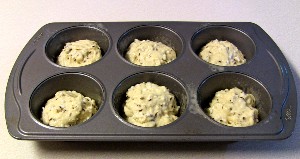
Step 4: Preheat the oven to 375°F. Use non-stick cooking spray or oil to prepare the muffin tins. Spoon dough into the muffin tins, filling each one about ¾ full. Let rise 10-15 minutes.
Caraway Puff Dough before baking
Step 5: Bake for 15-18 minutes until the muffins are browned. Rotate the tins halfway through the bake to ensure even baking. Brush with melted butter.
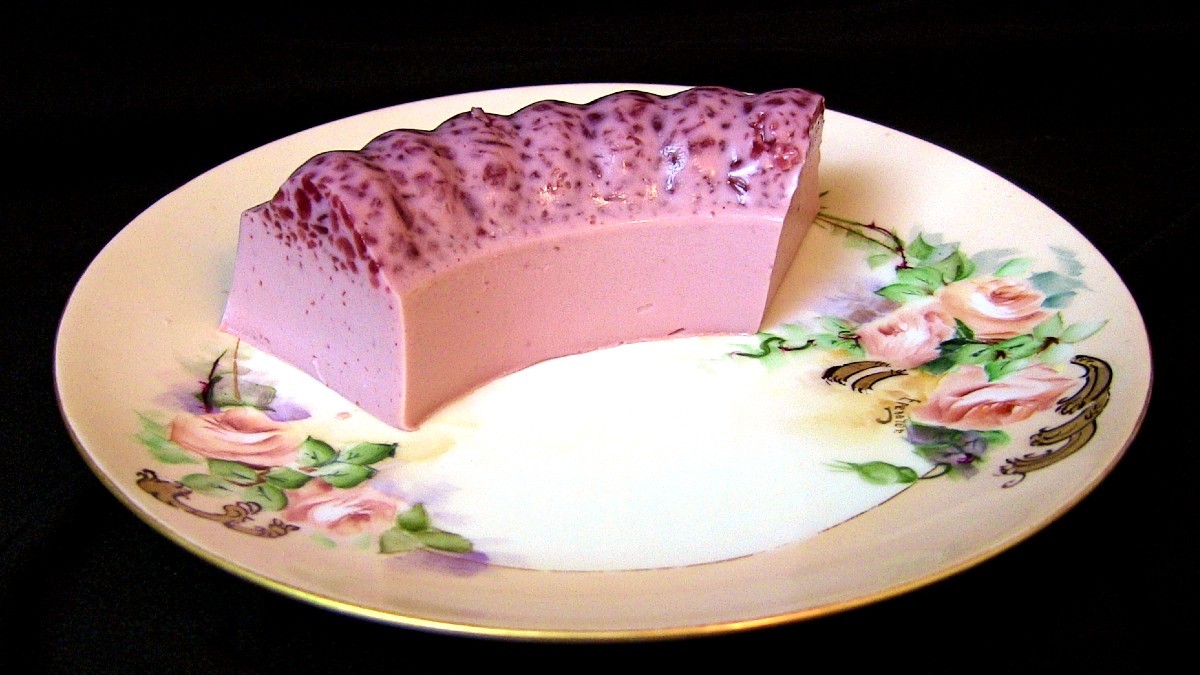
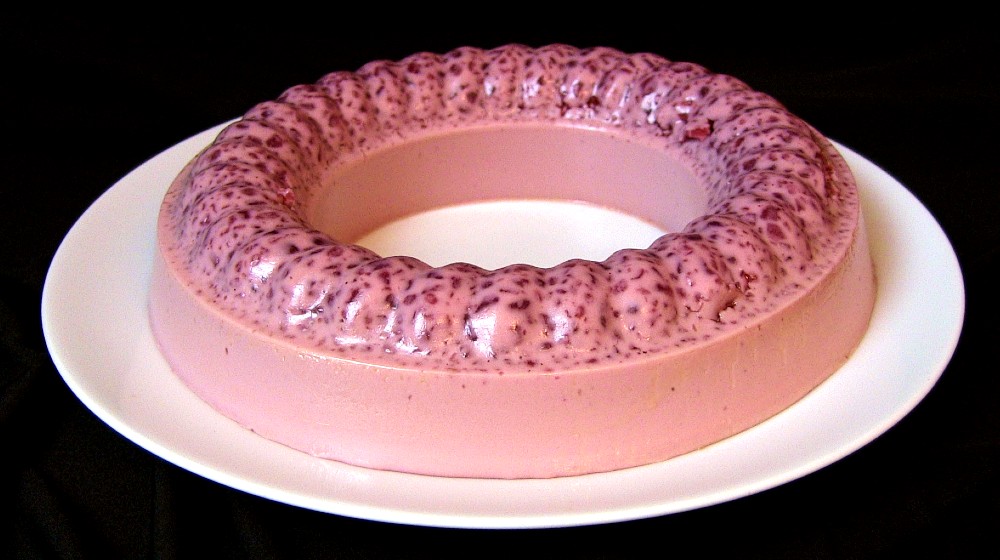
The inspiration for this recipe comes from a church cookbook of the early 1970s. It offers zingy tartness and solves the mystery of what to do with a can of jellied cranberry sauce.
Jellied cranberry sauce has always seemed as enigmatic to me as the monolith in Stanley Kubrick’s film 2001: A Space Odyssey.
Monolith, 2001: A Space Odyssey, Stanley Kubrick, 1968
Ocean Spray Jellied Cranberry Sauce
People must have uses for jellied cranberry sauce or supermarkets wouldn’t sell it, but the stuff kind of freaks me out when it comes out of the can. I really do love this salad, though. It’s light and tangy and is quick to throw together with just a few ingredients.
Of course, the original recipe called for artificially-flavored and nuclear-colored Jello mix. This is completely unnecessary because unflavored gelatin and fruit juice work perfectly well. The original recipe also called for diced raw celery and chopped nuts. That just seems wrong.
Old church cookbooks, and mid-twentieth century recipes in general, are rife with combinations of ingredients that just seem wrong. There’s actually a historical reason for this that has its roots in the social reform movement of the late 1800s and early 1900s.
Many recipes originated in The Ladies’ Home Journal, which began in 1883 and was the first magazine to reach more than a million subscribers. The early editors of the magazine were social reformers who campaigned not only for healthy diets, but also for a woman’s right to vote, clean cities and towns, and wildlife conservation. The magazine was part of a national social reform movement that brought about great changes like the end to child labor, the eight-hour workday and mental health reform.
While it’s easy to make fun of some of the odd combinations of ingredients that grew out of The Ladies’ Home Journal tradition, it is important to realize that malnourishment was common and serving food that was nutritious was of primary importance. Maybe a few oddball ingredients got shoehorned into recipes where they didn’t really belong, but current “foodie” sensibilities would probably have seemed frivolous to people of an earlier age.
This post is part of a series in which I am attempting to reinvent recipes from old church cookbooks of the 1960s and ’70s from the Upper Midwest. The goal is to reduce the over-reliance on sugar and salt as the dominant flavor enhancers and cut down on the pre-packaged convenience foods that became so common as ingredients at that time. However, it wouldn’t be Midwestern cooking if practicality weren’t an important feature; I won’t be hand-harvesting my own salt or rendering my own artisanal lard.
Ingredients:
341 grams (1 ½) cups Water
114 grams (½ cup) Unsweetened Black Cherry Juice
18 grams (2 tbsp.) bulk Unflavored Gelatin 250 bloom OR 2 packets Knox Unflavored Gelatin OR 8 sheets Unflavored Gelatin
14 oz. can of Jellied Cranberry Sauce (Ocean Spray highly recommended)
227 grams (1 cup) sour cream
Directions:
Step 1: Break up the contents of a 14 oz. can of jellied cranberry sauce and microwave on high for one minute. Stir until the mixture is smooth. Allow to cool for several minutes and then fold in the sour cream. Mix well.
Step 2: Combine cold water and cold unsweetened cherry juice in a medium sauce pan. Sprinkle gelatin onto the liquid and whisk. Let sit for 2-3 minutes. Heat the mixture over medium-low heat until the gelatin is completely dissolved. Gelatin dissolves at about 100°F. Do not let boil. The gelatin will not set if it is brought to a boil.
Remove the juice from the heat and blend in the cranberry and sour cream mixture.
Step 3: Use a little non-stick spray to coat a mold that is at least 6 cups. Transfer the mixture to the mold and refrigerate until set. Times can vary with gelatin dishes but plan to give it at least six hours.
Before setting
Step 4: After the gelatin is thoroughly set, use a spatula to gently pull away from the sides of the mold. Place a plate on top of the mold and flip. Allow the gelatin to drop from the mold naturally. Remember: gravity isn’t just a good idea, it’s the law.
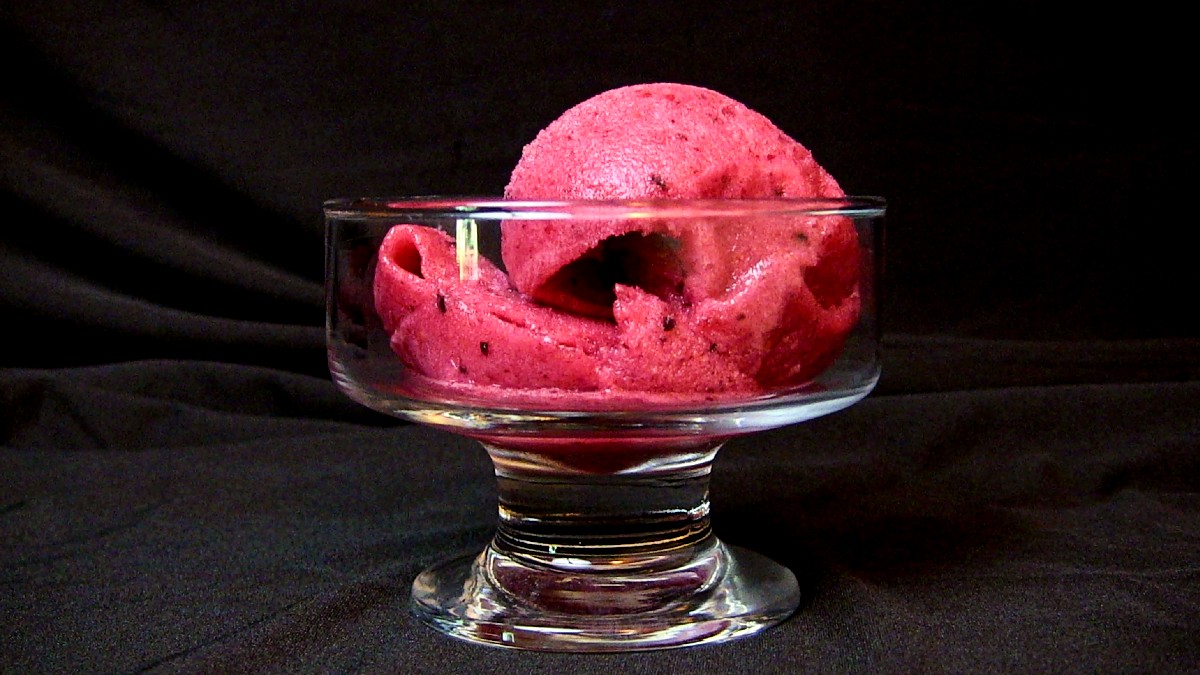
Sorbet is a light and refreshing way to enjoy the fruits of summer. Rhubarb is an ideal base not only because the high fiber content gives sorbet structure, but also because the tartness complements and supports the flavor of other fruits.
Victoria Rhubarb
We have seven Victoria Rhubarb plants and one Canada Red. In season, it can feel like we live on a small rhubarb farm. We’ve had to be creative to find ways of using so much. My partner, Debra, makes a wonderful curry with rhubarb and I make a yeasted No-knead Rhubarb Rye Bread. Excess amounts can be made into Rhubarb Shrub or Rhubarb Juice and canned.
It took about nine tries to get this sorbet right. At first, I tried adding small amounts of spices like cinnamon and cayenne to jazz things up, but I thought those flavors just got in the way. I tried using corn syrup because it was supposed to make the sorbet smoother. I thought it was just weird. The final version was the simplest and best.
Ingredients:
1 lb. Rhubarb, cut into one-inch chunks
4 cups Water
2 cups Sugar
1 to 2 cups other Fruit (mango, peach, pear or frozen berry blend work well)
1 tbsp. Lemon Juice
Directions:
Combine rhubarb, water, and sugar, and bring to a boil. Simmer for 10 minutes on medium heat, stirring occasionally. Refrigerate and cool the mixture thoroughly. Add lemon juice and other fruit and puree in a blender. Churn in an ice cream maker for 20 minutes and freeze. Makes 2 quarts.
Notes:
Victoria Rhubarb is the most common variety and was first introduced in 1837 by the English nurseryman, Joseph Myatt, who named it in honor of Queen Victoria.
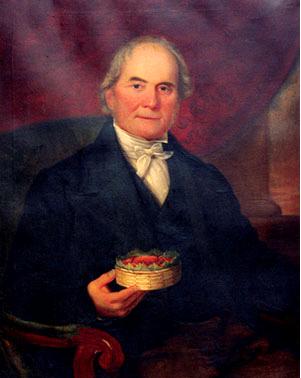
Joseph Myatt (1771-1855)
Joseph Myatt was a pioneer of rhubarb and strawberry growing in England. He was from humble origins but developed a thriving produce business in London.
A direct descendent of his maintains an extensive website on his life and I am reprinting sections describing the creation of Victoria Rhubarb in their entirety.
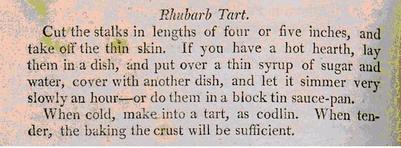
In the early nineteenth century rhubarb was not known as a food, but an expensive medicine called ‘physic’ sold by apothecaries. It was grown in Russia and Turkey where the roots were dried and powdered for use as a laxative. Around 1800 some English people had started to grow edible rhubarb; cultivating exotic plants was a common hobby among wealthy gentlemen. One of the first known references to rhubarb as a food is a tart recipe from Maria Elizabeth Rundell’s 1807 cookbook, reprinted in Alan Davidson’s Oxford Companion to Food.
Recipe for Rhubarb Tart
In 1815 gardeners at the Chelsea Physic Garden discovered by accident that if the rhubarb plant was covered and kept in darkness it produced sweeter, more tender shoots, so-called ‘forced rhubarb’. Another factor that started the change from medicinal plant to food was the arrival in England of cheaper and more accessible sugar imported from British colonies in the West Indies. Mary Eaton’s 1823 cookbook contained recipes for rhubarb tart, sherbet, soup, pie, pudding and sauce. The popularity of rhubarb was growing.
Joseph Myatt obtained a dozen rhubarb roots from his friend Isaac Oldacre. Mr Oldacre was an English gardener from Derbyshire who had risen to the position of gardener for the Emperor of Russia in St Petersburg. He had returned to England in 1814 bringing innovative gardening ideas and a supply of plants and seeds, including roots of Russian rhubarb. Mr Oldacre was now employed at the estate of the eminent botanist Sir Joseph Banks where he developed new methods for raising mushrooms in sheds and growing pineapples in hothouses. Isaac Oldacre and Joseph Myatt were the same age; perhaps they had worked together as gardeners at Prestwold Hall or elsewhere in years past.
Joseph Myatt’s first rhubarb crop at Camberwell was described as “of a kind imported from Russia, finer and much earlier growing than the puny variety cultivated by the Brentwood growers for Covent Garden”. Experimenting with forced rhubarb, Joseph developed large plants with enhanced flavour and texture and different colours. Famously, in 1824 Joseph sent his sons, James and William, to the Borough Markets with five bunches of rhubarb, of which they sold only three. The next week they took ten bunches, all of which were sold. Some have said that they took a recipe for rhubarb tart with them to promote sales. It was reported at the time that Joseph was ridiculed by green-grocers and his fellow market gardeners as “the man who sold physic pies”. It must have seemed ludicrous then to willingly eat a laxative pie. One green-grocer reportedly told Joseph’s sons that their previously esteemed father had taken leave of his senses. Joseph persisted with optimism. His positive attitude and intuition paid off; before long, rhubarb had become a favourite dessert on Victorian tables. Rhubarb production at Myatt’s Ground increased year by year.
Rhubarb production was still underway on a large scale at Manor Farm; by the 1850s it had become a familiar fruit in British cuisine. At the height of the season a thousand bunches a day were coming off Manor Farm. Joseph Myatt experimented with different hybrids of rhubarb producing cultivars of differing colour and flavour. One stalk of Myatt’s famous ‘Victoria’ rhubarb was said to have weighed up to seven pounds. ‘Linnaeus’ was another successful variety, first released in 1842. Joseph also managed to produce his ‘Early Eracta’ rhubarb in late winter, a great sales and marketing coup. In those days fruit was very welcome in the cold months when few fresh foods were available. In addition to selling rhubarb for food, the Myatts sold rhubarb plants to commercial and home gardeners.
The Quarterly Review (vol 89) of 1851 described the increased popularity of rhubarb: “Mr. Joseph Myatt of Deptford, a most benevolent man now upwards of seventy years of age, was the first to cultivate rhubarb on a large scale. The foot-stalks of the physic-plant are now regarded as a necessary rather than a luxury in culinary management. The most frugal table can display its rhubarb pudding or tart, in season.”
This account of the development of rhubarb was written in 1875: “Of late years this has become a much sought-for and important vegetable, but half a century ago it was scarcely known in the London market. The late Mr. Myatt, of Deptford, is looked upon as being the father of Rhubarb growers. The Deptford and neighbouring market gardeners at first thought that Myatt was mad upon the subject; but they soon found out that this was a paying job, and consequently took to growing it, as did the majority of the London market gardeners. Now it is almost universally grown.”
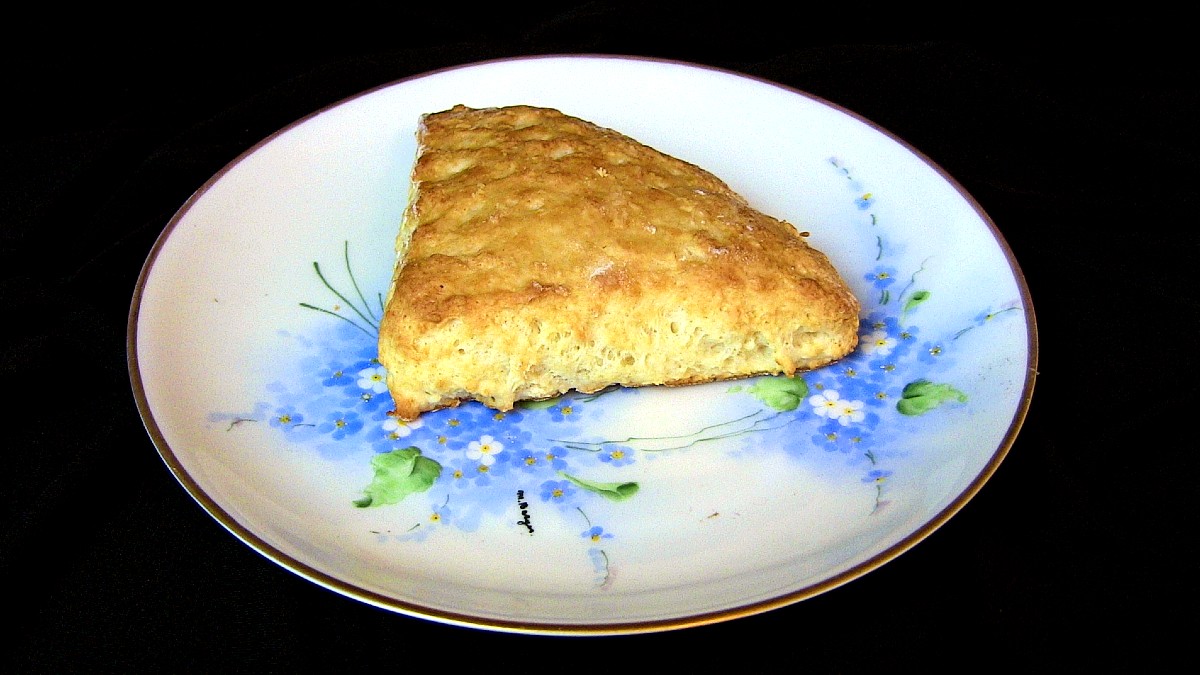
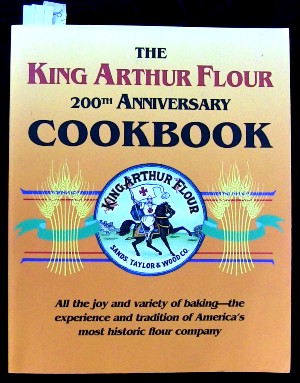
This recipe appears in the King Arthur Flour 200th Anniversary Cookbook, yet it does not appear in the recipe section of their website. I haven’t had luck finding it on other websites either.
This description is found in the book:
This entry came, via a friend of the Sands, from an English war bride whose husband flew for the Royal Air Force during World War II. They are light and delicious, the perfect Cream Tea Scone.
King Arthur Flour 200th Anniversary Cookbook
The cookbook is over 600 pages and, frankly, I find my blog easier to use, so even though I have no original contribution, here goes. The instructions are as found in the book with one additional note.
Ingredients:
180 grams (1 ½ cups) All-Purpose or Bread Flour
2 tsp. Baking Powder
½ tsp. Baking Soda
½ tsp. Salt
20 grams (¼ cup) Granulated White Sugar
227 grams (1 cup) Sour Cream
Directions:
Step 1: Preheat oven to 450°F. In a mixing bowl, blend the dry ingredients thoroughly. Scoop in the sour cream all at once and stir together for 20 seconds or until the dry ingredients are damp.
I spritz lightly with a little water to get the dough to hold together.
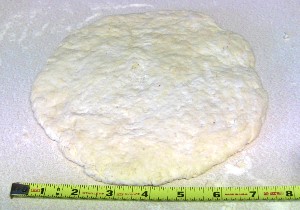
Step 2: Turn out onto a floured surface and knead, very gently, 8 to 10 times. This dough is very light. Roll into a round shape that is ½ to ¾ inch thick. Flour a spatula or bowl scraper well and cut into quarters.
Shaped into a round
Cut into quarters
Flour the spatula again and gently lift each scone onto a baking sheet that has either been lightly greased or covered with a silicone mat or parchment paper.

















 Schmecken!