Restorative rituals prove to have widely positive effects on mental health and emotional wellbeing, namely in decreasing anxiety, depression, anger and fatigue in favor of sleep, relationship satisfaction, self-esteem, empathy, and stress-relief.
So yipeee, let’s eat candy!
The wonderful Debra thought we needed to have an extra special daily ritual to look forward to this holiday season. You know, because of the whole deadly pandemic thing?
Last March, just as the Coronavirus furloughs were starting, Gastropod had a fascinating podcast called, “Licorice: A Dark and Salty Stranger” which I listened to while making an emergency drive to check in on the house of a friend who would not be returning from India anytime soon. You know, because of the whole deadly pandemic thing?
Debra found an Advent calendar from a boutique licorice maker in Denmark called Lakrids by Bulow. As we learned in the podcast, Scandinavians love them some licorice. We are sooo pleased to be looking forward to this simple daily ritual, from December 1st to Christmas, in this most unusual year. It’s not a little thing to have a simple pleasure right now. And to be grateful for it.
As one of the characters in Danish filmmaker Carl Dreyer’s film “Ordet” says, “I believe a lot of little miracles happen secretly.”
I hope this day finds you, and all those important to you, healthy and safe.
The temperature here should be good for this time of year so Deb and I will be putting a duck in the smoker and getting Brussels sprouts and purple carrots out of the garden. Deb will fancy-up some potatoes and bake them Hasselbeck-style and we’ll finish up with pumpkin pie.
We’ll have a conversation with our friend Jackie in Calcutta. Last night we Skyped with friends while we all ate dinner together. We’ll make more connections with family and friends like that today as well.
I’ve been thinking a lot this year about my parents growing up on farms during the Great Depression. My dad’s family spent 30 days quarantined in their house because of Scarlet Fever. That was a real lockdown. At worst, I have to deal with inconvenience.
I’ve also thought a lot about the London Blitz in World War II and kept their motto of “Keep Calm and Carry On” in mind.
We’ve spent a lot of time making our home life better. We planted a big garden and canned a lot of pasta sauce. We blanched and froze a lot of vegetables. We continued to convert more of our lawn over to native prairie plants and enjoyed the increased pollinator and wild critter activity.
We’re out of step with the dominant culture. I’m supposed to be incensed that the pandemic has slightly interrupted my ability to get instant gratification through the marketplace. But I’m just not.
I hope we don’t go back to the way things were before. I would hope we can do a lot better than that.
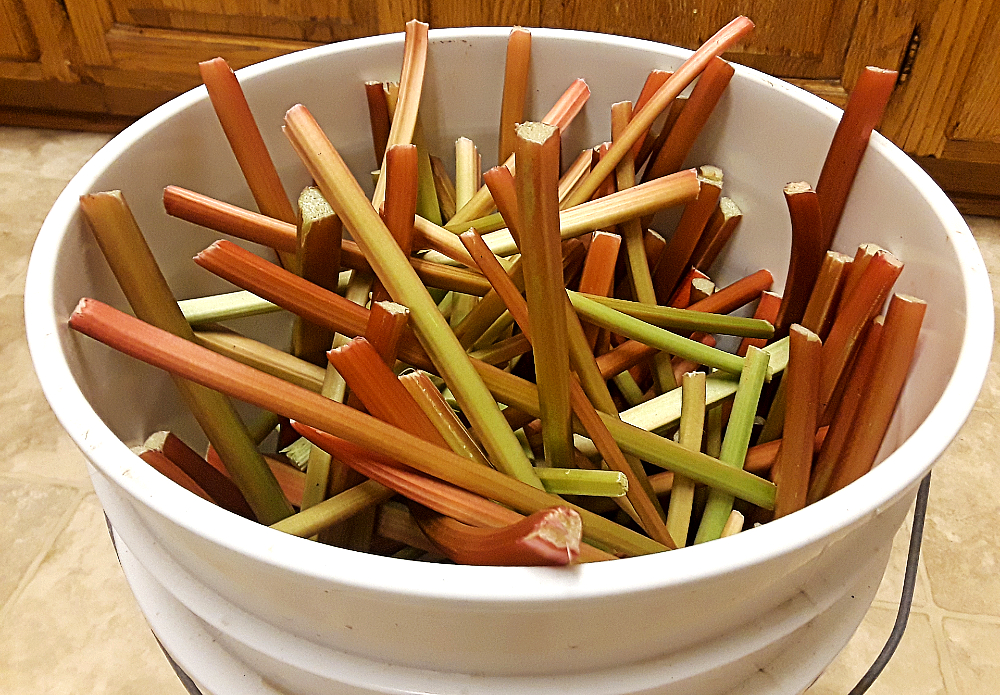
The fourth day of July in the year of our Lord 2020 brought forth a country in the grip of pestilence and the Presidency occupied by the Antichrist. It also brought forth an abundance of rhubarb due to some pretty decent growing conditions this spring. Life goes on.
I harvested a huge amount from seven plants this morning. It will allow all the little hidden shoots at the base room to grow and there should be plenty more to enjoy this season.
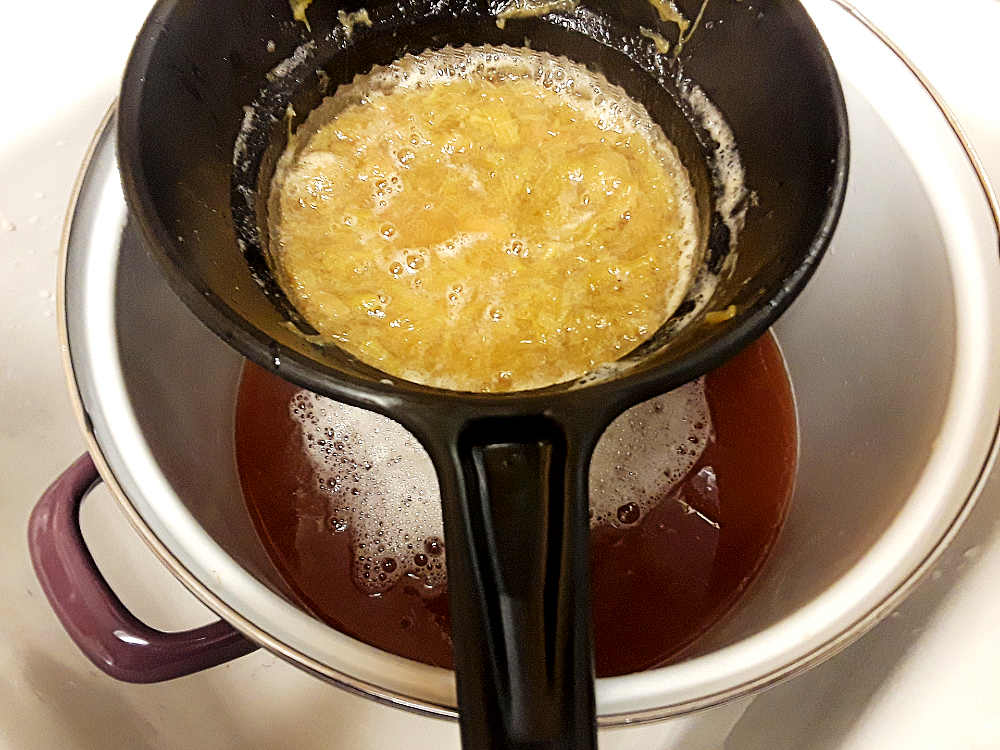
With such a large quantity to deal with at one time, I thought canning shrub would be a good way to preserve a reminder of summer for the winter months. A few tablespoons of shrub in an 8-ounce tumbler of sparkling water puts a zing into any day.
Shrub is essentially a simple syrup made with fruit, vinegar and sugar. People have been making shrub as a way to preserve food since before people wrote such things down. I’m certainly not inventing anything new. This is a standard recipe. My 10½ lbs. of rhubarb yielded 5 quarts of shrub which I preserved using the water bath canning method.
Yield: 1 Quart
Ingredients:
2 lbs. Rhubarb, cut into half-inch chunks
1 cup Vinegar, white or cider
1 cup Sugar
Directions:
Combine ingredients and bring to a boil for 10 minutes. Strain through a chinois or cheesecloth.
I needed to replenish electrolytes this past Sunday because it was hot – July come early hot – and I had a lot of outdoor work to do. Rhubarb is a surprisingly decent source of potassium and trace minerals. I came up with this recipe a few years ago and it’s a refreshing way of making sure a bumper crop of rhubarb doesn’t go to waste. A small amount of sugar takes the edge off the sharpness and a small amount of cinnamon and cardamom add just enough to make it interesting.
I had one of those moments doing yard work when the space/time continuum evaporated like sweat in a summer breeze. The gap between my 15 year old self and the man I am now closed in an instant when I came in from working outside in 91°F. heat and quickly drank a glass of rhubarb juice. The sensory impressions of working long hours on the farm with my dad, usually in silence, in the summer heat came flooding back. In a flash, the sights and sounds of the time and place I grew up in seemed to be real and in the present moment.
There’s a timelessness to working in the sun. The rhythms and pace of the days don’t change no matter what the era because the Heat knows it’s the one really in charge.
Once in a while I’ll catch a glimpse of myself in a piece of glass and I don’t think the reflection looks like me. My shoulders are hunched and I don’t walk with the same smoothness of gait anymore. I’ve played the role of Sisyphus for too long.
But every once in a while the intervening years melt in the heat while working in the sun and it’s the same as it ever was …
Ingredients:
2 lbs. Rhubarb
1 Gallon Water
¼ cup Sugar
1 stick Cinnamon
10 Cardamom Pods
Directions:
Combine ingredients and boil for 10 minutes. Strain and, if canning, process by the water-bath canning method for 10 minutes. It’s important to study the USDA Guide for Home Canning if you’ve never tried home canning before.
Tim Brooke-Taylor passed away on April 12, 2020 from Covid-19. His career ran the whole course of the great British satire movement of the 1960’s, from its early days when he was a student at Cambridge with classmates like John Cleese and Graham Chapman, on through various comedy troupes of the decade when he teamed with virtually all the comedy giants of his era as a writer and actor. The era culminated with some of his former colleagues creating Monty Python’s Flying Circus and he with his own long-running show, The Goodies.
The era was kicked off by a comedy group called Beyond the Fringe, made up of Peter Cook, Dudley Moore, Jonathon Miller and Alan Bennett. They had a sketch that satirized documentaries about World War II that has made me draw a parallel to the times we are living in now.
Jonathon Miller, Alan Bennett, Dudley Moore and Peter Cook of Beyond the Fringe
At all the staggeringly important moments of World War II, one of the characters in the sketch begins his recollection by saying, “Well, I was out in the garden at the time …”
When his wife comes out to tell him about the latest most staggeringly important news, his reaction is to always say, “There, there, dear … let’s just go in the house and have us a nice cup of tea.”
I think that guy was on to something. As someone who comes home every night wondering if he’s just put a gun to his partner’s head by working in an office all day, I can tell you that you can’t live in a state where you’re fully realizing the enormity of every minute of every day. You have to go out in the garden sometimes. Sometimes, you just have to sit and have a nice cup of tea.
This is going to be a long haul. There aren’t going to be any quick fixes. You don’t want to be like those pitiful, disgusting, right-wing freakazoid protesters in Michigan. You’re going to want to craft a home worth going home to. Even if it’s a home that only exists in your mind. It’s going to be a long haul without it.
On a lighter note, we’ll probably all be like the characters in “The Four Yorkshiremen” sketch one day and complain about how kids these days don’t know how good they have it. The late Tim Brooke-Taylor gets a credit as a writer and performer along with John Cleese, Graham Chapman and Marty Feldman. It’s been voted the greatest British comedy sketch of all time.
Tim Brooke-Taylor, John Cleese, Graham Chapman and Marty Feldman in “The Four Yorkshiremen.”
I have a personal perspective on the psychological consequences of being caught in the crosshairs of a global economic meltdown. I was a small business owner during the 2008-2009 economic crisis. It was like standing in front of an avalanche and it didn’t make any difference which way I ran; there were no good options. And I was too small potatoes for any of the mover-and-shaker types to care about.
In many ways, being a small business owner in America has just been an extension of The Gig Economy, with many small business people insured through Medicaid and existing on a cash-flow basis, working 65 hours-a-week on the hope that it will all work out in the end.
In the psychological counseling world, they talk about losing the sense of self. In America, your identity is tied to your job status and in the years that followed when I said that I had to close my business because I could not find a buyer I certainly felt like people regarded me as a loser. Some of my identity went into exile.
I once was the guest for dinner in the home of a family who had been refugees from Burundi. They came to the United States after spending years in refugee camps. They literally were exiles.
I was welcomed into their home on a few acres of Iowa farm ground they were renting, working hard to develop a vegetable-growing business. I was struck how the flow of the evening and the setting was so reminiscent of the many evenings I had spent growing up on another farm in Iowa at another time.
It was a cold and rainy evening in early November. The main course was a hearty soup. A steaming, wobbling white orb of starch called Fufu, made by long, vigorous stirring of cassava flour and water, sat in the middle of the table and served a dual purpose; it not only occupied a large space in the stomach once eaten, but by tearing off a chunk of it and cradling it with the first three finger of your hand, it could then be used as a spoon by making an indentation with the thumb and ladling the soup from bowl to mouth. Very efficient, really, and quite filling.
Fufu is also known as Bugari and it carries an almost mystical significance to the identity of many people from Africa the same way every culture seems to have foods that trigger a deeply ingrained response. The daughter-in-law who made the bugari that night said,
“I could eat bugari every day. It makes my belly feel so full and makes me feel strong! A lot of people eat rice instead of bugari, but if I eat a lot of rice I just want to lie down and sleep. When I eat bugari I feel strong!”
After dinner, the father went outside to check on livestock and the mother, daughter, and daughter-in-law cleaned up, telling stories and joking while moving between the languages of Kirundi, Swahili, English and, sometimes, French. I’d lived that pattern myself many times growing up. Farming is farming.
It occurred to me that these exiles from central Africa were engaged in reinventing their conception of Home. They were keeping alive what traditions they could and reinventing Home on a few acres of farm ground that had once been Iowa prairie.
There will be a lot of people who experience trauma because of a crisis they did not cause. The myth that Americans like to tell themselves is that God is secretly picking the winners and losers and that he’ll do you a solid if you’re one of the people who try to pick themselves up by the bootstraps. When that doesn’t work – and it won’t for a lot of people through no fault of their own – their notion of who they are is going to be shaken. They will have to find a psychological place where they can reinvent Home.
I hope that this time around people who experienced loss because of this crisis will be viewed as still having value. That miserable profession known as Human Resources needs to actually regard humans as resources. Economic Development professionals need to pay attention to all those small business people who got suckered into paying their Chamber of Commerce dues with nothing to show for it.
I hope there will be real counselling help from real licensed professionals available and not just a bunch of Dr. Phil crap.
I hope people who have to reinvent Home can do it without building walls to keep out whatever scapegoats the demagogues gin up hatred for.
There are rewards to being open. I made a 15 minute film about a ceremony honoring the memory of a man who had been a refugee from Bhutan. He had been a farmer and entrepreneur who had to flee his homeland because the King of Bhutan ginned up ethnic hatred for people of Nepali heritage. After many years in a refugee camp, he and his family came to Des Moines, Iowa.
After his passing, his family dedicated a marble bench in front of the refugee center where he learned English and took citizenship classes. The bench sits at a public bus stop which will be used by other newly-arrived refugees for years to come. In the film, many people talk about how enriched their lives were by knowing this man despite barriers of language and culture. The man and his family reinvented Home and all the people who knew him were better for it.
Family and friends pay tribute to the memory of a man who had been a refugee of Nepali heritage from Bhutan through a Hindu Puja ceremony dedicating a marble bench at a public bus stop in front of the Refugee Connection Center of Lutheran Services in Iowa (LSI) in Des Moines.
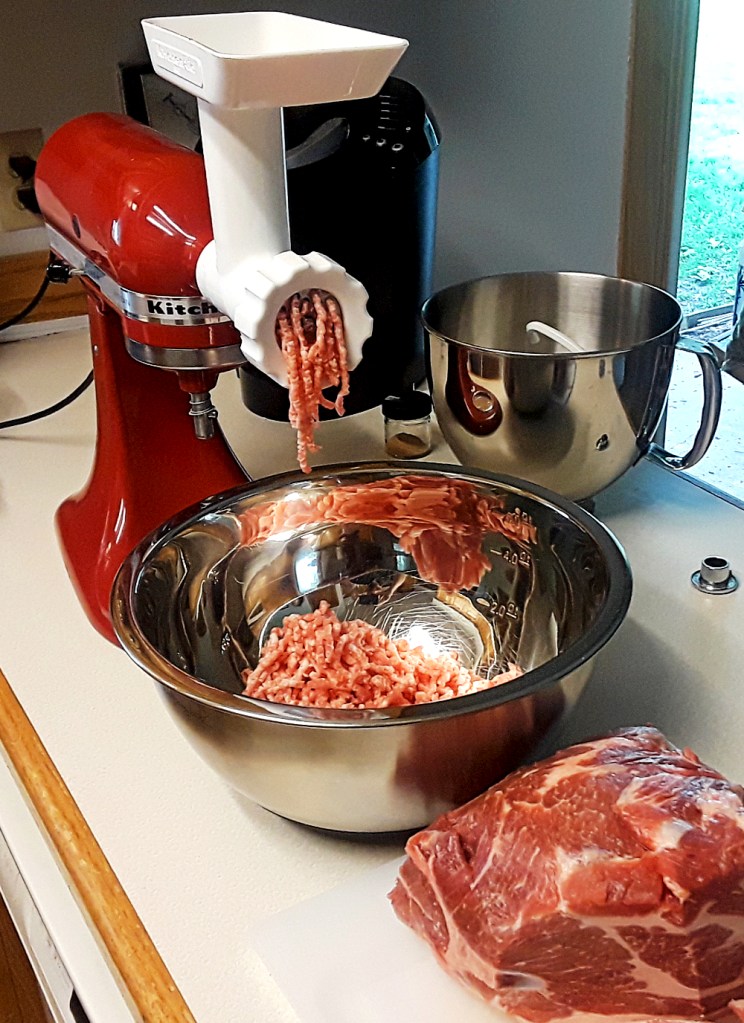
Lately, the stocking up I’ve been doing during The Great Sequestration has centered on using the FoodSaver™ vacuum sealer to preserve meat for the long term. I usually keep a couple large pork shoulders I find on sale in the chest freezer; I decided to run one of them through the fine-grind plate of the KitchenAid meat grinder and make sausage.
A few years ago I adapted a recipe for English Bangers from Ellen Brown’s “The Sausage Cookbook Bible” to make a loose sausage that went into a Christmas Pie. One of the real keys is to use fresh-ground threads of mace and not use the pre-ground stuff that loses all the subtle flavor notes and tastes like medicine.
My 6.79 lb. pork shoulder plus added bacon wound up yielding 7 lbs. 9 oz. of loose sausage that will keep very well vacuum sealed and frozen.
Ingredients:
1 lb. Ground Pork
¼ lb. Bacon, finely chopped
1 tsp. Mace Threads, freshly ground
½ tsp. ground Ginger
1 tsp. ground White Pepper
¼ tsp. Nutmeg, freshly ground
1 tsp. dried Sage
1 tsp. Kosher Salt
Mix thoroughly by hand before cooking.
Notes:
According to The English Breakfast Society, bangers can be a slang term for any sausage but the one we most commonly think of is a breakfast sausage.
It was a happy accident that we stumbled across genuine mace threads. We had just been looking at pictures of them online when I found unmarked packets of them in a bulk bin at the Namaste Indian Grocery Store nearby a couple years ago.
Mace was an incredibly popular spice that has fallen out of fashion. Just like nutmeg, it needs to be freshly ground to be fully appreciated. That’s the big reason why that bottle of ground mace has been sitting in your mom’s spice rack since 1973.
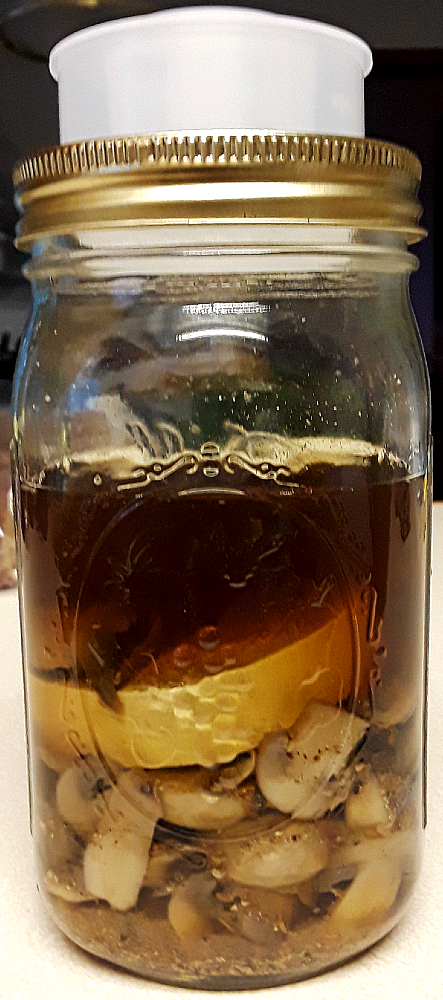
The Great Sequestration has started me thinking more about food preservation as a matter of necessity and not just as a good foodie thing to do. When we did our first ever online grocery order, button mushrooms were on a crazy-good sale and I found a recipe for Polish preserved mushrooms. Fermentation is the preservation method, something I’ve been doing for a few years now.
I used dried herbs I already had in the house and the salt content is a little over 4% of the weight of the mushrooms in order to have a safe fermentation.
After four weeks fermenting, the result tastes slightly pickled with a hint of garlic, the sourness coming from the fermentation. They’re probably best served as an hors d’oeuvre. Fermented mushrooms are traditionally served on rye bread and are also great on crackers.
Ingredients:
8 oz. (228 grams) Button Mushrooms
1½ cups Water
10 grams (2 tsp.) Redmond Real Salt
1 tsp. Dill Seeds
1 tsp. Caraway Seeds
1 tsp. Granulated Garlic
2 tsp. Ground Black Pepper
Directions:
Step 1: Bring the spices and 1½ cups water to a boil in order to dissolve the salt. Let cool.
Step 2: Wash and scrape off any dirt on the mushrooms. Slice into quarters. Boil the mushrooms for five minutes, strain and rinse with cold water. Transfer to a sterilized fermentation vessel and add the cooled spice mixture. Submerge the mushrooms with a weight and cover the vessel. Ferment for 3 – 4 weeks, remove the weight and refrigerate.
Notes:
There are a number of home fermentation kits on the market that utilize mason jars. I happened to find the Ferment’n Home Fermentation Kit at a natural foods store and it works pretty slick. The important key for fermentation is to use a sea salt that is between 3 – 5 % of the weight of the produce you’re working with.
Everybody needs to have a quick bread recipe in their back pocket that they can throw together with ingredients they pretty much always have on hand. Preserved lemons and dried cranberries make this one my go-to.
Ingredients:
1 cup Dried Cranberries, re-hydrated
Dry Ingredients:
240 grams (2 cups) Flour
3 tsp. Baking Powder
½ tsp. Kosher Salt
Wet Ingredients:
198 grams (1 cup) Sugar
1 tsp. Kosher Salt
2 tsp. Vanilla Extract
¼ Preserved Lemon, rinsed and chopped (about ¼ cup)
1 Large Egg
99 grams (½ cup) Canola Oil
114 grams (½ cup) Water
Directions:
Step 1: Preheat oven to 300°F. Hydrate one cup of cranberries in just enough water to cover.
Step 2: In a bowl, mix dry ingredients.
Step 3: In a small saucepan, combine wet ingredients and heat just until the sugar is dissolved and the ingredients are smooth. Don’t overheat or you’ll scramble the egg.
Step 4: Lightly coat a 9 x 5 loaf pan with oil or shoot with non-stick spray. Strain the cranberries and add to the flour mixture. Coat the cranberries thoroughly with flour; this helps to keep them from sinking to the bottom of the loaf. Add wet ingredients and mix until just combined. Pour mixture in the pan and bake for 75 minutes. Allow to cool thoroughly.
Notes:
This makes for a couple nice gifts if you divide this in two of those disposable 8 x 4 aluminum foil pans. Simply pour about 430 grams of batter in each tin and bake for 65 minutes.
Food preservation is a household management skill that is taking on renewed importance now during The Great Sequestration. Preserved Lemons are a delicacy that’s so easy you’ll want to slap your forehead and say, “Why have I never done this before?”
Just about any time a recipe calls for lemon zest – and , of course, you don’t happen to have a fresh lemon on hand – you can substitute preserved lemon. A quart jar takes no time to make and can keep in the fridge for months.
I’m presenting a basic version and one called Moroccan Preserved Lemons taken entirely from The Splendid Table’s How To Eat Weekends by Lynn Rossetto Kasper and Sally Swift.
Basic Preserved Lemons
4-5 Lemons, thoroughly washed and cut into quarters lengthwise; enough to pack into a quart jar
½ cup Sea Salt or Kosher Salt
1-2 cups Lemon Juice; enough to cover the lemons in the jar
Step 1: Wash and sterilize a quart jar and lid. Wash the lemons and slice into quarters. Roll each quarter in salt until thoroughly covered.
Step 2: Pack the lemons into the quart jar and add the remaining salt. Don’t skimp on the salt. Add enough lemon juice to cover the lemons. Put on the lid and give a good shake.
Step 3: Let the jar sit out at room temperature for a week. Shake up the jar every once-in-a-while during this time to make sure the salt dissolves. After a week, they are ready to use and can then be stored long-term in the refrigerator.
Step 4: Whenever a recipe calls for lemon zest or lemon flavor, simply cut off a portion of preserved lemon and rinse. You can cut out the pulp part if you like and just use the rind if it looks neater in your dish. Otherwise just dice finely and add to your dish. Voila – lemon flavor any time you need it!
Moroccan Preserved Lemons
4-5 Lemons, thoroughly washed and cut into quarters lengthwise; enough to pack into a quart jar
½ cup Sea Salt or Kosher Salt
4-inch Cinnamon Stick
1 tsp. Coriander Seeds
3 dried Bay Leaves
1-2 tsp. Crushed Red Pepper flakes
1-2 cups Lemon Juice; enough to cover the lemons in the jar
Step 1: Wash and sterilize a quart jar and lid. Wash the lemons and slice into quarters. Roll each quarter in salt until thoroughly covered.
Step 2: Add the spices to the quart jar. Pack the lemons into the jar and add the remaining salt. Don’t skimp on the salt. Add enough lemon juice to cover the lemons. Put on the lid and give a good shake.
Step 3: Let the jar sit out at room temperature a week before storing long-term in the refrigerator. Shake up the jar every once-in-a-while during this time to make sure the salt dissolves.
Step 4: Whenever a recipe calls for lemon zest or lemon flavor, simply cut off a portion of preserved lemon and rinse. You can cut out the pulp part if you like and just use the rind if it looks neater in your dish. Otherwise just dice finely and add to your dish. Voila – lemon flavor any time you need it!