Homemade Sauerkraut

I’m struck how old school food preservation methods like fermentation and home canning are suddenly, urgently, relevant again for their original purposes – to ensure a steady supply of nutritious produce at the household level.

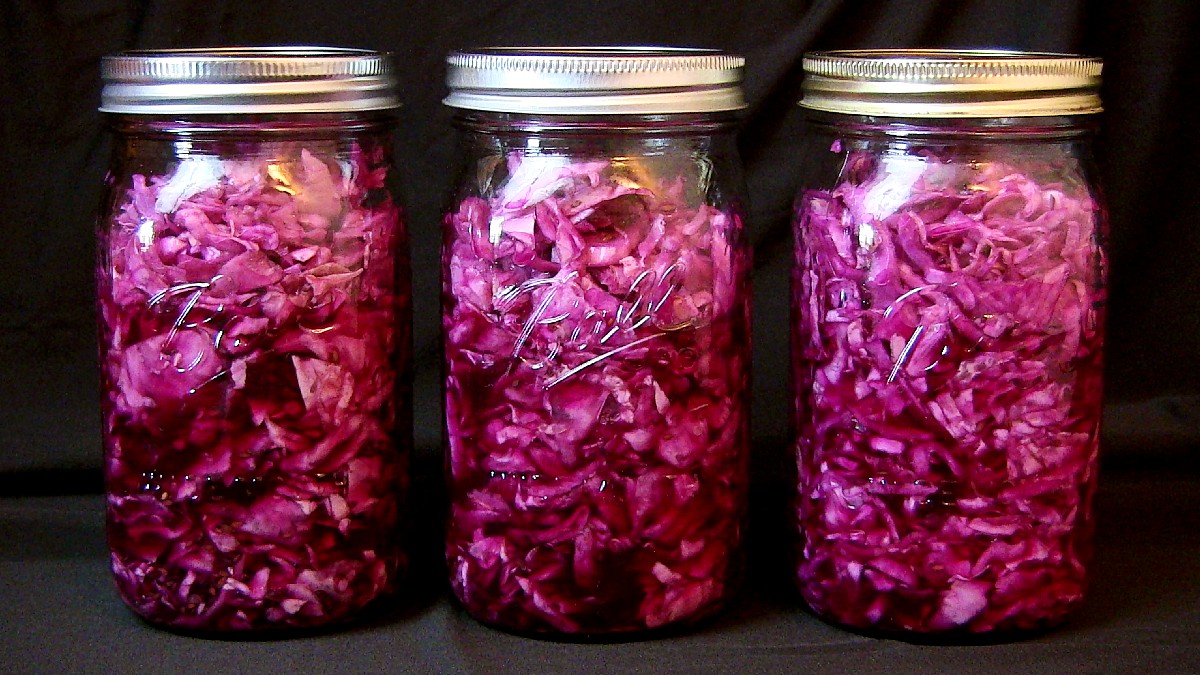
I had one quart of homemade kimchi left when sequestration was imminent and decided to give sauerkraut a try in order to have a supply of probiotic-rich fresh produce. After three weeks of fermentation, the result is a salad that is as fresh and crisp as the day it was first made and loaded with anthocyanins and enzymes.

Ingredients:

  • 2-3 lbs. (1 – 1 ½ heads) Red Cabbage, core removed and shredded
  • 46 grams (3 tbsp.) Redmond Real Salt or fine grind Himalayan Pink Salt
  • 1 tbsp. Caraway Seeds
  • 1 tbsp. Dill Seeds
  • ½ tbsp. Juniper Berries, lightly crushed (optional)
  • 1½ cups Water
  • ½ cup White Distilled Vinegar

Directions:

Step 1: Remove outer leaves and core a large red cabbage. Run the cabbage through the shredder blade of a food processor.

Step 2: In a large bowl, mix together the cabbage, salt and spices. The amount of salt used should be about 3% of the weight of the produce for safe fermentation and that works out to about 3 tablespoons of Redmond Real Salt or Himalayan Pink Salt for an average-sized red cabbage.

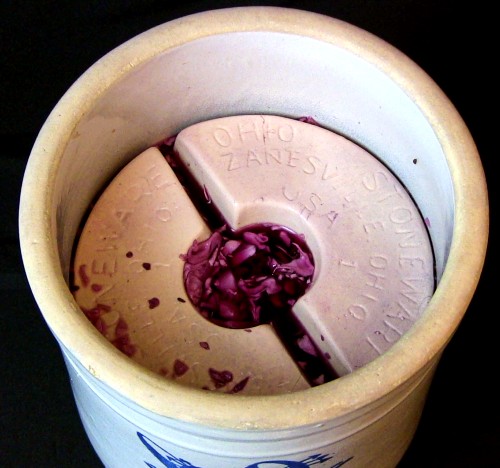
Step 3: Transfer the mixture to a freshly cleaned fermentation vessel and add the water and vinegar. Press down the mixture with weights so that liquid covers the cabbage. Cover the vessel and allow to ferment for at least three week.

A little water may need to be added to cover the mixture.

Step 4: After the desired fermentation time, transfer the sauerkraut to sterilized jars and refrigerate. It will keep for months.

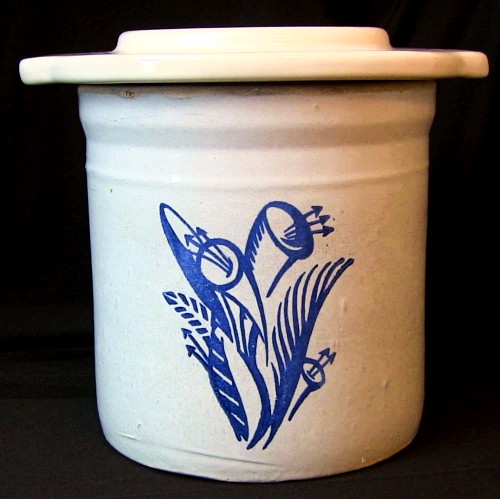
Sauerkraut Crock with weights
A one gallon crock with weights and heavy stone lid from The Ohio Stoneware Company.

Notes:

The Ohio Stoneware Company makes fermentation kits that can be ordered from Ace Hardware online and delivered to a store in your area for pickup.

Covid Loaf

England has a healthy bread called Hovis Loaf that goes back to the 1880’s. It holds a warm spot in the hearts of the British and a commercial for Hovis Loaf was voted “Best TV Ad Ever” in Great Britain. It was directed in 1973 by Ridley Scott who went on to direct such films as “Alien” and “Gladiator.”

We are hunkered in and making the best use of the resources we have on hand. We are keeping calm and carrying on. We are channeling our inner Dunkirk and remembering our Depression-era parents and grandparents. We are watching a lot of British Mysteries on Public Television.

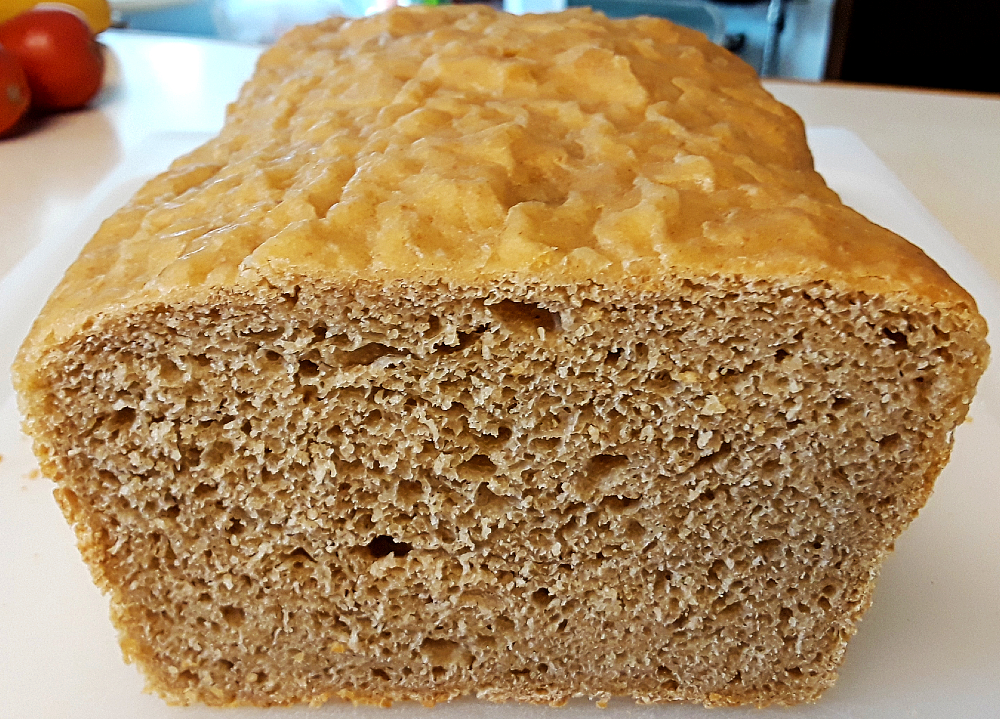
And from time to time we need bread and having a decent amount of fiber is important because…well…it just is. Fresh resources are precious, and I did not want to use an egg so the rise on this bread did not turn out all that elegant. I did not want to use oil in the dough because we need to save that for cooking.

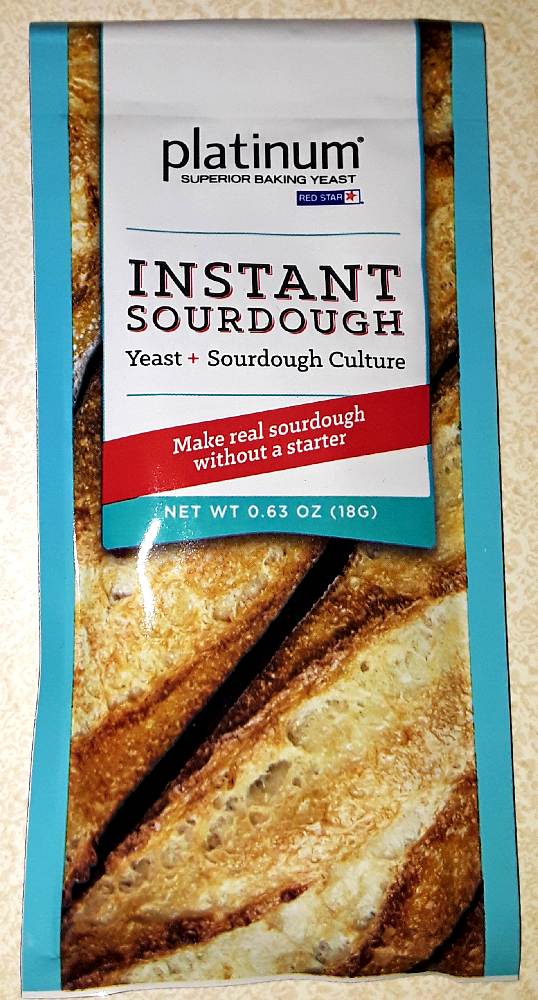
But I do have a large quantity of Red Star Platinum Instant Sourdough Yeast on hand because Fareway was selling it for 99 cents-a-packet a few months ago and I stocked up. I was afraid they were thinking of discontinuing it and had marked it down. By not adding sugar, the flavor of the sourdough comes through strong, but, because it does not have sugar, it did not brown on top particularly well.

We do, however, have a lot of butter on hand because Hy Vee was selling it for $1.88 a pound before Christmas and we stocked up then. The loaf looks much better after brushing on melted butter.

It features a 60/40 ratio of bread flour to white whole wheat and the result is a soft, moist bread that showcases the tang of sourdough yeast.

Ingredients:

  • 327 grams (2⅓ cups) White Bread Flour
  • 218 grams (1⅔ cups) White Whole Wheat Flour
  • 2 tsp. Kosher Salt
  • 1 packet Red Star Platinum Instant Sourdough Yeast
  • 350 grams (1 ⅔ cups) Warm Water
  • 1 tbsp. Butter, melted

Step 1: Combine dry ingredients. Add water, mix and knead for about 10 minutes, either by hand or using the dough hook on a stand mixer. Set aside in an oiled bowl and let proof until doubled in size – about an hour.

Step 2: Lightly oil a standard 9 x 5 bread loaf pan or shoot it with non-stick spray. Knock back the dough and turn it out on a floured surface. Knead the dough for several minutes until smooth. Place the dough in the pan and form into an evenly distributed oblong shape. Let rise until the dough starts to form a dome above the rim of the pan.

Step 3: Preheat the oven to 350°F. Bake for 20 minutes, then tent the bread with aluminum foil and bake for an additional 20 minutes. Remove the foil and bake uncovered for five more minutes until brown on top. Brush the top of the loaf with melted butter and let cool.

Ontbijtkoek, the Dutch Gingerbread Recipe

A friend who was traveling had to layover in the Amsterdam airport and brought home a cake called “Ontbijtkoek.” I’m not exactly sure how to pronounce it. This commercial is the best I can do.

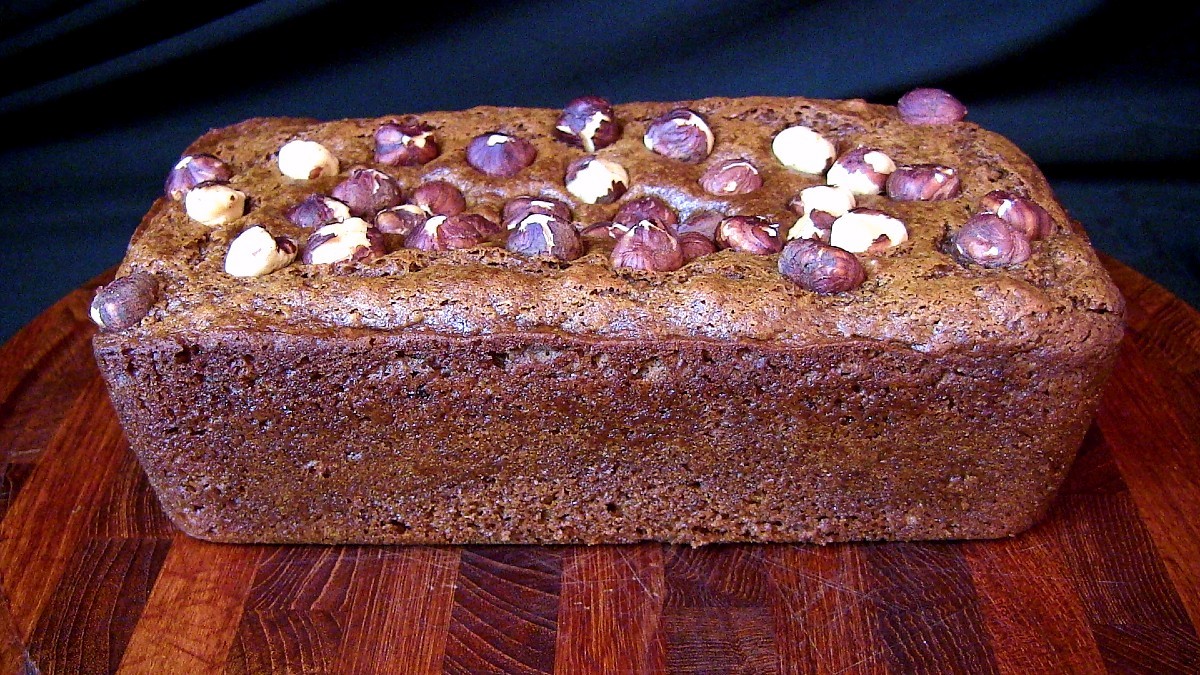
The cake from the airport probably measured four inches high, was covered in hazelnuts and had a distinct flavor of orange peel. The texture was fairly light. We liked it so much I thought I would try to recreate it. As I soon discovered, the commercial versions of ontbijtkoek may be lighter and less dense than the traditional versions, perhaps due to featuring less rye flour than has been typical of that style. It’s possible that a lighter product is more appealing to a mass market.

Most of the traditional recipes for ontbijtkoek I found online that were in English were basically the same recipe but I went with this one from Ena Scheerstra as the basis because it features more spices than the others. It’s kind of a cross between a cake and a quick bread and traditional ontbijtkoek features rye flour as one of the main ingredients. The flavor is reminiscent of gingerbread. None of the traditional recipes I found online had hazelnuts or orange peel. The texture is similar to banana bread.

I did quite like the spice flavor of the traditional recipes, so I tried to make a hybrid of the two versions. To make it more like the cake my friend bought in the airport, I’ve added orange zest and arranged hazelnuts on top. I’ve added an egg to give the bread more rise. I’ve also altered the ratio of white flour to rye flour from 50/50 to 60/40 in order to give it a little lighter texture while still keeping the rye flavor. I think the orange zest may actually be optional since the cake is so flavorful without it, but I do quite like having the crunch from the hazelnuts.

Dry Ingredients:

  • 145 grams (1⅓ cups) All-Purpose Flour
  • 95 grams (⅔ cup) Rye Flour
  • 1 tbsp. Baking Powder
  • ½ tsp. Sea Salt
  • 1 tsp. Cardamom, ground
  • 1 tsp. Cinnamon, ground
  • ½ tsp. Ginger, ground
  • ½ tsp. Coriander, ground
  • ¼ tsp. Cloves, ground
  • ¼ tsp. Nutmeg, freshly ground
  • ¼ tsp. Black Pepper, freshly ground
  • ⅛ tsp. Aniseed, crushed

Wet Ingredients:

  • 1 cup Milk
  • 100 grams (¾ cup) Brown Sugar
  • 170 grams (½ cup) Honey
  • 75 grams (¼ cup) Molasses
  • 1 Large Egg
  • 1 tsp. Vanilla Extract
  • Zest of 1 Orange (optional)

Topping:

36 Hazelnuts

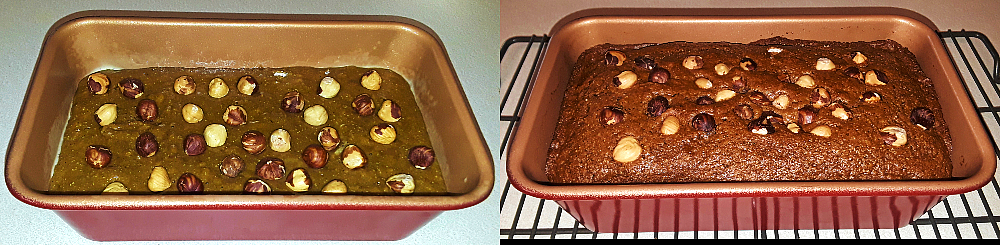
Before and after baking at 300°F. for 70 minutes.

Directions:

  1. Preheat the oven to 300°F.
  2. Mix all-purpose flour, rye flour, baking powder, salt and spices in a bowl.
  3. In a small saucepan, heat milk, brown sugar, honey, molasses, egg, vanilla extract and orange zest, if using, until the brown sugar is dissolved and the ingredients are blended.
  4. Combine the wet and dry ingredients and mix until the ingredients just come together. Overmixing will affect the rise of the bread.
  5. Spray a 9 x 5 inch loaf pan with non-stick cooking spray and pour the batter into the pan.
  6. Arrange 36 hazelnuts across the top of the batter in a randomized pattern.
  7. Bake on the center rack for 70 minutes.
  8. Remove from the oven and allow to cool. Many people think it tastes better the next day.

Notes:

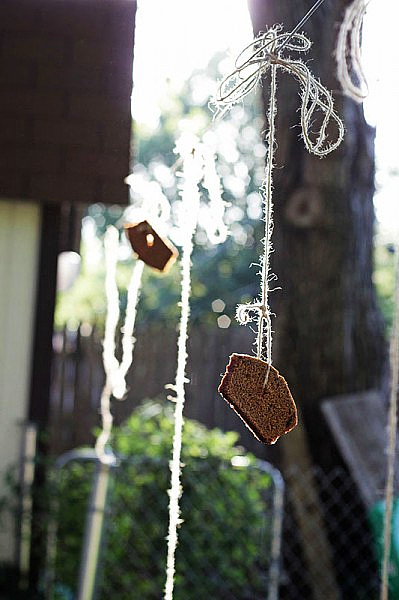
The Dutch have a game called “koekhappen” in which slices of ontbijtkoek are hung from tree branches and children try to take bites out of them without using their hands.

Photo from http://globaltableadventure.com/recipe/recipe-dutch-spice-cake-on-a-rope-ontbijtkoek/

Spiced Honey Cakes go back to at least Roman times, but the modern version of gingerbread in Europe can be traced to an Armenian monk who later became a saint named Gregory of Nicopolis. In the year 991, he traveled from modern day Turkey to France to escape persecution from the Persian Army.

Saint Gregory of Nicopolis

Gregory became a popular holy man and he taught the French his recipe for a cake featuring honey and spices in the tradition of his homeland in Armenia. To this day, the tradition of making gingerbread lives on in the Loire Valley of France where he lived. From there, the recipe spread across Europe and England, with bakers innovating with local ingredients, like rye flour, along the way. This Dutch version owes its long list of spices to the influence of India because of the Dutch East India Company.

In short, the whole European tradition of gingerbread making can be traced to Saint Gregory of Nicopolis. Ontbijtkoek is a regional variation on this ancient tradition and is perfect to serve for breakfast at Christmas time.

Drinkable Cheap Coffee

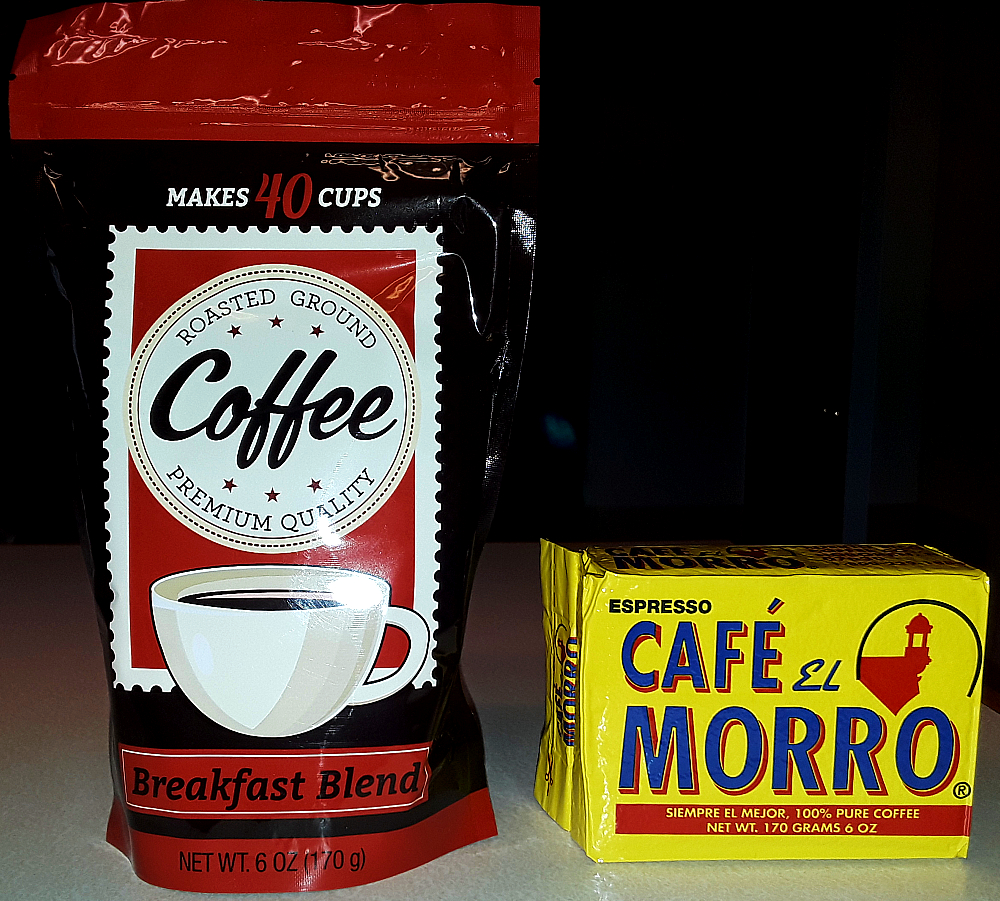
Cheap coffee from Dollar Tree.

I actually do know what good coffee tastes like.

So, before I write about cheap coffee, I want to state that I am actually rather picky about the coffee I drink. In fact, when I owned a natural foods store about 30 miles south of Iowa City, Iowa, I carried and served coffee from Cafe del Sol, which was probably Iowa’s first premier coffee roaster.

I had a friend who knew the owner and arranged for me to visit. The owner, Stephen Dunham, gave me a tour of his facility just outside Iowa City in nearby Coralville and explained the virtues of his roasting process. He explained that the most common type of coffee roaster uses a heated metal drum to roast the beans. The hot metal drum rotates and the beans scorch against the inside of the drum as they tumble. It’s a closed system and the chaff that breaks off the beans as they tumble can ignite and form a kind of tar on the beans. When people complain about the bitter taste and acidity of coffee, they are actually describing an undesirable byproduct of the roasting process.

Cafe del Sol uses a system that roasts the coffee using hot air that is forced up through the beans and has an exhaust system that sucks out any chaff that breaks off from the beans. The result is a cleaner product that showcases the bean’s true character.

When I’m working with fine quality beans, I use a burr grinder to grind them and I prefer using the Melitta cone filter method to brew coffee with water that is just coming to a boil. I’m quite partial to Kenya AA and Ethiopian Yirgacheffe.

So, just to reiterate, I actually do know a thing or two about good coffee.

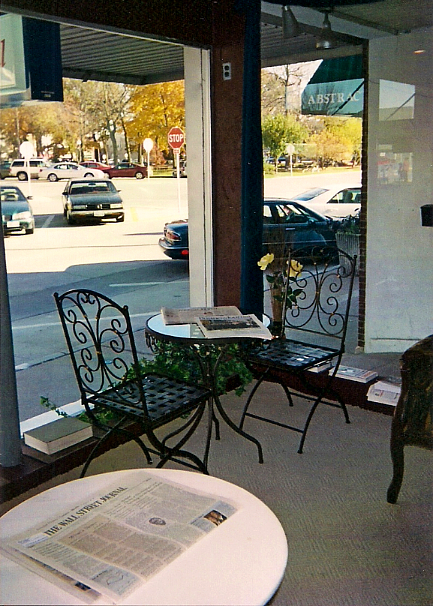
The coffee and tea room of my store.

But I also know when I’m overpaying for a mediocre product and there’s a lot of mediocre coffee masquerading as premium out there. After staying overnight in a house with only decaf, I happened to stumble across an ultra-cheap coffee combo that I think is perfectly drinkable for every day use. I’ve certainly paid a lot more for a lot worse coffee.

Dollar Tree sells a six-ounce bag of a medium roast called Breakfast Blend and a six-ounce bag of espresso called Café El Morro, each for a dollar. Each one is okay to drink if you’re in a pinch, but blended together they’re surprisingly decent.

I use 21 grams of coffee to make a pot that comes up to the eight cup line on my carafe. The two six-ounce bags blended together equals 340.194 grams. At 21 grams per pot, that means I can get 16.1997 pots out $2.00 worth of coffee. There are quite a few grocery store chains that are selling 12 oz. bags of their store-brand coffee for about $10.00 that do not taste nearly as good as my Dollar Tree hack.

I figure I can make a year’s supply of drinkable coffee for about $45.00. I could easily spend $225.00 for a year’s supply of coffee that is so not worth it.

If I just need some go-juice to get started in the morning before work I’ll be perfectly happy with my Dollar Tree blend. Then I can splurge for a truly premium bag of freshly roasted single-bean coffee and savor it when I have the time to really appreciate it.

Pickled Green Tomatoes or Tomatillos, 1 Quart

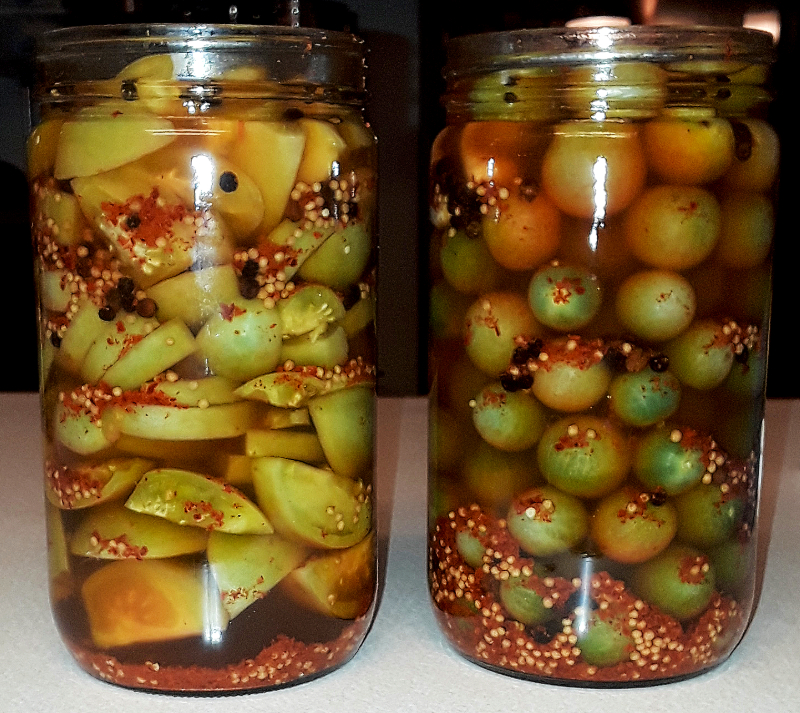
Green tomatoes cut into wedges are on the left and green cherry tomatoes are on the right.

It can be a challenge to find a use for green tomatoes at the end of summer. The origins of this recipe are long forgotten, but making it couldn’t be simpler and the results are fabulous after about 48 hours. Since green tomatoes are seasonal, substituting tomatillos are a good option since they are usually available year round, especially at Latino grocery stores. Just make sure to rinse off the sticky coating after removing the outer husks.

Ingredients:

  • 1 – 1¼ lbs. Green Tomatoes or Tomatillos, cut into wedges
  • 4 whole Garlic Cloves
  • 1¼ cups Water
  • ¾ cup White Vinegar
  • 1 tbsp. Sugar
  • 1 tbsp. Kosher or Himalayan Salt
  • 1 tbsp. whole Peppercorns
  • 1 tbsp. whole Mustard Seeds
  • 1 tsp. Red Pepper Flakes

Direction:

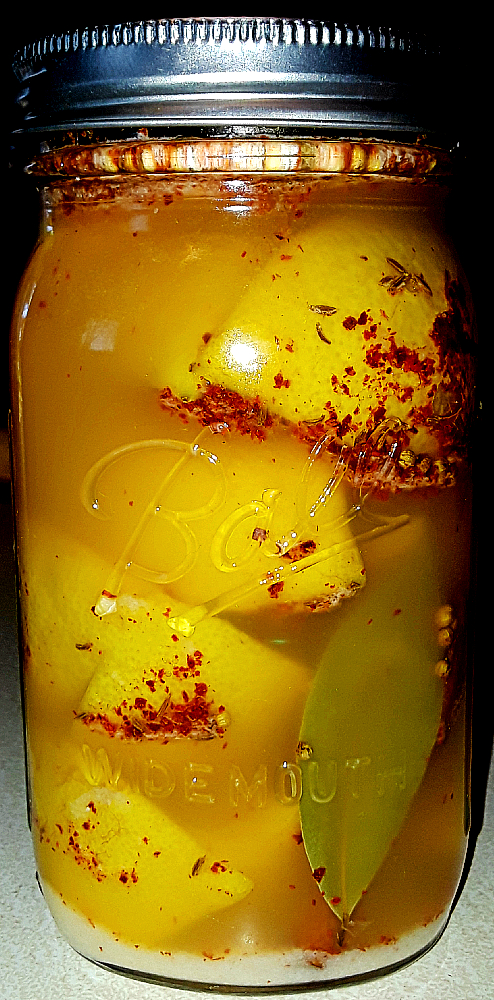
Cut the tomatoes or tomatillos into wedges and pack into a quart jar with the garlic cloves. Bring water, vinegar and spices to a boil and remove from the heat. Pour over the tomatoes or tomatillos and, if necessary, top up with water or vinegar and refrigerate. They are best if they cure for at least 48 hours. They can be kept in a refrigerator for up to 5-6 months, but it’s doubtful they’ll last that long.

Notes:

It’s thought that pickling originated in northwest India and India continues to enjoy a robust pickling tradition.Spicy pickle mixes and chutneys are a routine accompaniment to meals and there are important health reasons for including bitter flavored foods with a meal.

According to Dr. Andrew Weil, eating bitter foods can have the effect of curbing hunger, so having a few bites of something bitter at the start of a meal can almost trick your mind into eating less. Bitter foods help to moderate blood sugar levels and stimulate the liver to produce bile which help us digest fats and makes fat-soluble vitamins more available. According to Weil,

“Bitter foods challenge the liver. They make it work and help it to remain healthy, just as muscles challenged by exercise function better than ones that atrophy from underuse.”

According to one study, starting a meal by eating vegetables and proteins before consuming carbohydrates helps to keep insulin and blood glucose levels lower. So having a few bites of your own homemade quick pickles with your meals will not only give you the satisfaction of creating gourmet-level flavors, it will also benefit your health.

Star Dawn

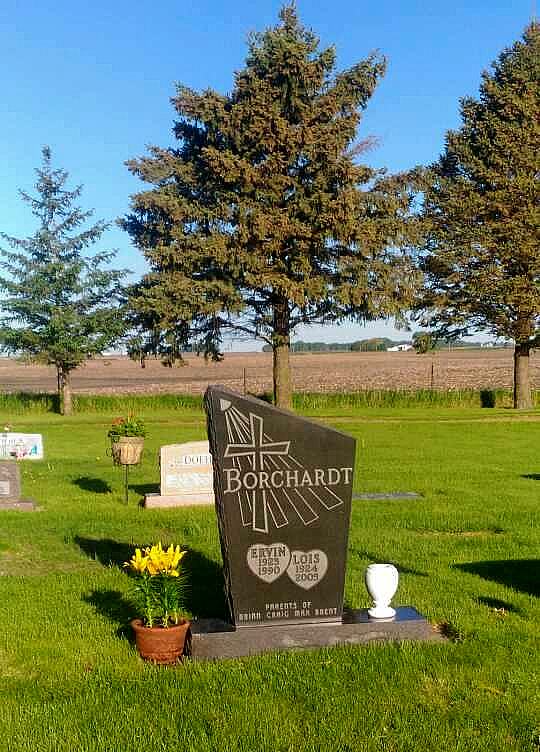
St. John’s Lutheran Church Cemetery, Fenton, Iowa

There’s a sight that brings a smile to my face when I stand a short distance in front of my parent’s gravestone. I can look out and see all the old farmers I grew up working for who lived near us: Eddie and Virgene Uthof, Lloyd and Dorothy Kern, and Willard and Hulda Menz. It’s like the old neighborhood is still together in a quiet little cemetery a half-a-mile out of town in the countryside.

This was a group of farmers who all grew up in the 1920’s and ’30’s and sharing equipment and labor for jobs like baling hay and shelling corn was common.When they had been teenagers, large crews of neighbors took turns using a 20-ton steam engine to power a machine called a thresher that separated grain from the plant stalks.

It was hard work but it was also an extremely important social event for the whole neighborhood. They were called Threshing Parties and there was a festive atmosphere to the whole enterprise. It took large crews of neighbors – men, women and children – to do the work and provide all the food required to pull off a big operation like that. I could tell from the way the old-timers talked that those had been some of the happiest days of their lives.

I was lucky enough to get a sense of what that life was like and to hear their stories, but even then I was aware that I was experiencing something that was ending and never coming back. The U.S. Secretary of Agriculture in the early 1970’s, a man named Earl Butz, told American farmers they should get big or get out. A few years ago, I talked on the phone with our neighbor, Virgene Uthof, on the night she passed away and we talked about how the old neighborhood was not like it used to be. It’s all big farmers now.

I think in many ways I have been looking for, and almost never finding, that same sense of camaraderie and appreciation in my own working life that I experienced with those old farmers then. I knew that I was working with others toward a common purpose and that my work was valued. I have almost never experienced that in my adult working life.

I was never really prepared for office politics. I seem to be a magnet for the petty, niggling coworker and the supervisor who acts as their enabler. I still feel like I have talents to give, but I work in a lot of places where I’m not really wanted on the team.

I even moved to a small town and owned a natural foods store because I wanted to be my own boss and feel a sense of connection to a community. Instead, I always felt like I was caught between a nativist group of townspeople who didn’t want outsiders coming to “their” town and the town’s cultural elites who did not think I was sophisticated enough to be in “their” town either.

I have wanted to have a sense of connection to others through my work and for my work to be treated as having value. For the most part, that has just not been the case.

When I think of how the old farmers I knew are now near each other in that cemetery back home, I think of Thornton Wilder’s play “Our Town” and how the characters at the end of the play speak to each other in the cemetery they now occupy. It’s an image of the afterlife that seems out of place in the world I inhabit.

Is there a human consciousness that lives on after we die or do our atoms just split up and find new adventures? If we are just atoms that split up, that actually doesn’t sound all that bad to me.

I like to imagine the afterlife being like a piece of music called “Star Dawn” by Alan Hovhaness. It’s a 14 minute-long symphony that imagines a space flight taking off from Earth and landing on a distant planet. The music of Alan Hovhaness reminds me of a spirit world because he uses bells a lot and when I hear the “tinkly” parts of his music I think of a world that people can sense but maybe not see because it is a world that exists within arm’s reach but just out of sight. In this piece, the “tinkly” sounds combine with “bing-bongy” sounds that make me think of flying through space. If my Spirit leaving sounded something like this music, I think I’d be okay with that.

Neal Smith National Wildlife Refuge

Since the old neighborhood isn’t what it used to be and I don’t have the same connection to it anyway, I think I would like to wind up at The Neal Smith National Wildlife Refuge in Prairie City, Iowa.They are restoring the Iowa countryside to be like what the natural prairie was in 1840 before the land became dominated by industrialized agriculture. I honestly do not know if there is a personal God who knows the number of hairs on my head or if we are all part of The Energy that makes up The Universe, but if I could be a part of a landscape that can make use of me, well, then that sounds like a pretty satisfying way to live on.

MSG

I once had occasion to shadow several cooks of Nepali heritage who had been refugees from Bhutan. I observed them cooking a meal, writing down every ingredient as it was prepped and every step as the dishes were made. I then turned my notes into a standard recipe format that others could follow.

There was a very skillful interpreter on the scene, but, for the most part, a potato is a potato and an onion is an onion. However, there was one mystery ingredient that kept popping up that we had trouble identifying. The interpreter, who is a fantastic cook herself, knew what it was but could not come up with the English word for it. The first cook we observed had bought it in bulk and stored it in an old honey jar, so no help there.

It was a white, slender, crystallized flake with no hint of aroma. When I took a pinch of the flakes and popped them in my mouth my first thought was, “It tastes like vegetable soup.” I went home that night, fired up the Google machine, and went off on a search. Because of that hint about vegetable soup and because my partner and I like to peruse mom-and-pop ethnic grocery stores for fun, I was able to figure out – fairly quickly, really – that the mystery ingredient was none other than Monosodium Glutamate – the dreaded MSG.

I’ve never given MSG any real thought beyond doing the cultural shorthand that a lot of people do: MSG = Bad. It’s the Chinese Restaurant Syndrome thing, right? But what did I really know about it? Given it’s reputation, it would not have surprised me if it was made from the same stuff as lawn fertilizer.

I came across an article published in The American Journal of Clinical Nutrition called The History of Glutamate Production by Chiaki Sano. In 1907, a Japanese professor wondered what it was about the taste sensation he got from his wife’s soups that he just couldn’t put his finger on. It wasn’t exactly sweet or salty or sour or bitter which were the four accepted categories that taste buds were supposed to be able to taste.

What professor Kikunae Ikeda thought he was tasting did not match those categories, at least not exactly. With his wife’s help, he was able to determine that a type of seaweed called kombu, which was a traditional flavoring agent of soup stocks, was the source of the unique flavor.

He figured out that an amino acid called L-glutamate was responsible for a new taste he called “umami.” He was able to concentrate L-glutamate and crystalize it. MSG became one of the most widely used food additives across SE Asia because it adds great flavor to vegetarian dishes. There’s a parallel between MSG and Nutritional Yeast, which is also used to give umami flavor to vegetarian cooking, but which does not have the negative reputation that MSG does.

Both MSG and Nutritional Yeast are derived from fermentation. For MSG, the bacteria strains Corynebacterium glutamicumBrevibacterium lactofermentum, and Brevibacterium flavum produce L-glutamate when they gobble up the sugars in molasses and beet sugar.

Nutritional yeast is made from the Saccharomyces cerevisiae bacterium and is also grown in beet sugar or molasses. It is then deactivated by heat and does not go through a crystallization process like MSG does. It’s vegan-friendly, tastes similar to Parmesan cheese, and has about as positive a reputation as it gets in the natural foods world.

For the sake of accuracy, I picked up a bag of MSG when I recreated the dishes made by the Nepali cooks. I’ve made the dishes with and without MSG and I do believe that adding MSG makes a noticeable difference. For those too freaked out by the thought of intentionally consuming Monosodium Glutamate, Nutritional Yeast can be substituted for MSG teaspoon for teaspoon.

As for me, I don’t think there is anything to get wigged out about and it sounds like chefs like David Chang aren’t either. There’s a reevaluation of MSG going on in the chef world. When cooking for myself, I’ve been adding it to soups and vegetarian dishes, though I don’t usually include it when cooking for others. It adds a different dimension of flavor and since it is a crystal it dissolves and blends cleanly.

It’s crazy how MSG and Nutritional Yeast can be so similar and have such wildly different reputations. I do think Jeffrey Steingarten’s comment about MSG probably says it all: if MSG is so bad, how come there aren’t a billion Chinese people walking around with headaches all the time?

Portuguese Broa Cornbread

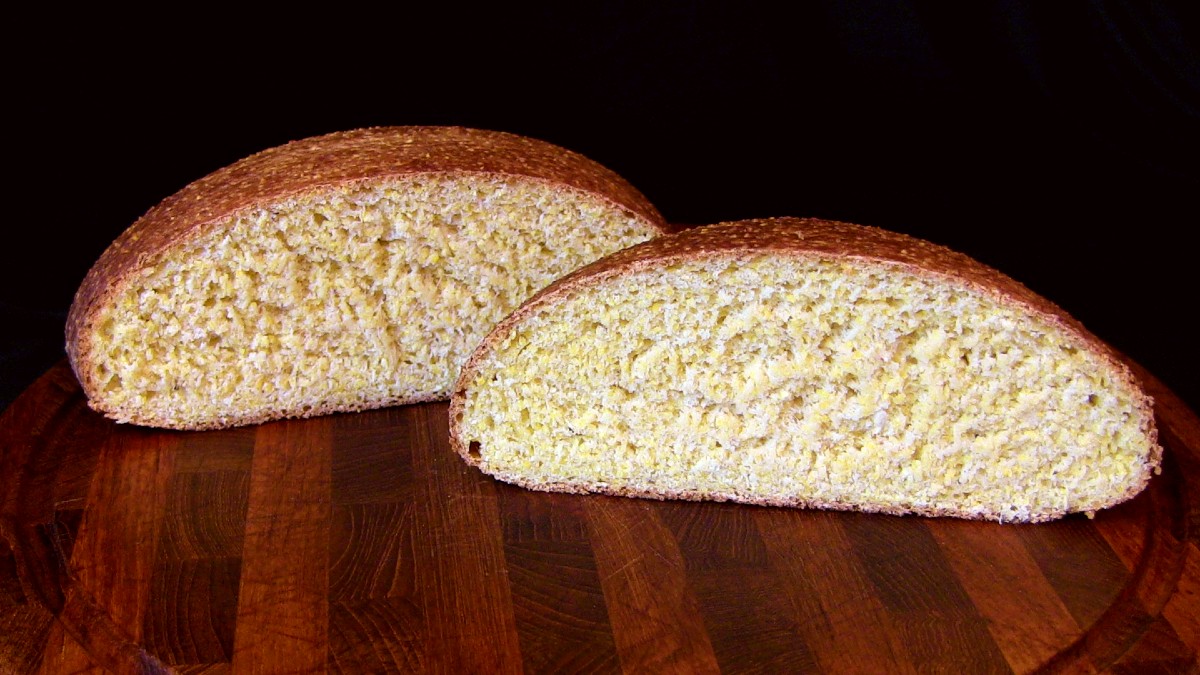
As the weather cools down, soups and chili fit the season and it’s nice to have a really good bread for dunking. Two things about this cornbread got my attention: it only needs one rising time and it uses yeast to rise instead of the baking soda and baking powder typical of American-style cornbread.

I compared about a half-dozen recipes and tested a few batches before settling on this combination as one that works well for me. My one contribution to the genre is that I’ve added an egg. An egg can help a bread rise and make it a little less dense and I thought this bread really benefited from that.

It’s great to have a bread that is ready to go in the oven in half the time of other homemade breads. It’s light and holds together well; it doesn’t dry out after one day and crumble into pieces like the typical skillet cornbread does.

Ingredients:

  • 326 grams Bread Flour (2 ⅓ cups)
  • 218 grams Fine Corn Meal (1 ½ cups)
  • 50 grams (¼ cup) Granulated White Sugar
  • 2 tsp. Yeast (1 Packet)
  • 2 tsp. Sea Salt
  • 25 grams (2 tbsp.) Vegetable Oil
  • 1 Egg
  • 272 grams warm Water ( scant 1 ¼ cups)

Directions:

Step 1: Combine the dry ingredients and mix well. Add the vegetable oil, egg and water and knead for ten minutes. This is an extremely sticky dough, so if you have a stand mixer with a dough hook you should definitely use it.

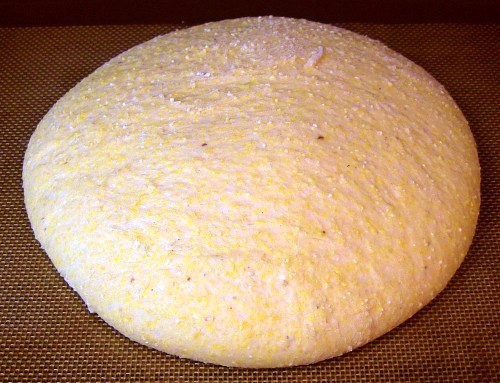
Step 2: Generously dust a surface with flour and shape the dough into a round ball and set aside to rise for an hour on a baking tray covered with a silicone mat or parchment paper. The dough will not rise much, but will have a nice oven spring.

Cornbread Dough after one hour of rising time

Step 3: Bake for 30 minutes in an oven that has been preheated to 425°F. Rotate the baking tray half-way through to help with even browning. Let cool on a wire rack.

Notes:

There’s a certain school of thought that says bread should only be made of whole grain flour, salt, water and sourdough yeast, and, as much as I like reading Michael Pollan, I think he gets he gets his shorts in a bit of a wad on this subject. There are other ingredients that have perfectly legitimate roles to play.

Sugar is important in bread because it is hygroscopic, meaning it retains moisture. Adding sugar helps prevent bread from drying out so it can help a loaf stay moist. Oils are fats and fats help keep the interiors of breads tender while keeping the exteriors delicate and crisp. Adding an egg helps with giving dough a good rise.

There’s a kind of puritanism that views white flour as an abomination. However, completely 100% whole grain breads tend to be dense, without enough gluten to get a good rise, and they dry out quickly. I find that about 60% white flour to 40% whole grain flour is kind of a sweet spot. It’s enough to get a decently risen loaf with plenty of character from the whole grain.

Whole wheat flour tends to go rancid fairly quickly and inexpensive, high-protein white flour from Canada and the United States literally saved millions of people the world over from malnutrition in the 1800’s. Check out episode two of Victorian Bakers for a real eye opener about how treacherous it was to be a member of the working class in England at that time just trying to eat. It’s right out of Charles Dickens because … it’s right out of Charles Dickens. (All four parts of the Victorian Bakers series are entertaining and educational.)

There’s gotten to be a thing where some people insinuate that the kind of yeast people buy in the grocery store might as well be derived from plutonium and that commercial yeast is compromising people’s immune systems. There are many different strains of saccharomyces cerevisiae and some strains are simply better than others at fermenting the sugars in flour. Science has helped us get better at identifying them. Some strains of yeast are better than others when used to brew beer, but if you try using brewing yeast to make bread you’re likely to be disappointed. If you want to make sourdough, fine, make sourdough. But condemning commercial yeast because it’s not “artisanal” enough is just kind of silly. Then again, I guess you can’t spell “artisanal” without spelling “anal.”

Mass Communications

In the 1920’s and ’30’s, my grandparents farmed in Freedom Township, which is a rural area east of Emmetsburg, Iowa. According to family legend, when Charles Lindbergh flew The Spirit of St. Louis across the Atlantic Ocean in 1927 and landed in Paris, my grandfather set his wind generator-powered radio in front of the speaker of the party-line telephone so all their farm neighbors could listen to the news as it happened in those days before rural electrification.

I love that story because it it points out how less than a hundred years ago we lacked the basic infrastructure needed to now spend, for the first time in human existence, the majority of every waking minute of our lives engaged in consuming some form of mass communication.

In a fascinating podcast from The Food Programme on BBC Radio, Chef Magnus Nilsson makes the case that he believes the world’s most diverse baking culture can be found in the Nordic countries because the populations of those countries were so isolated and spread out that information spread very slowly. If one home cook came up with a highly individualized recipe or technique, that innovation might spread only a few miles by being handed down through the generations. Perhaps unique and highly local traditions were not bulldozered if the residents were not targeted by marketers to replace anything old with anything new?

I sometimes like to look through old community cookbooks because I hold onto the hope that I will find some lost gem of a recipe that was the unique creation of a gifted cook from the past living in a small town in the Upper Midwest of my heritage. I am usually disappointed. Most often, the recipes in community cook books are pretty universal, with only slight variations made by the individual cooks.

I recently stopped by a wonderful used book store in Mankato, Minnesota called Once Read Books and purchased the 1871-1971 Centennial Cook Book of The Albion Lutheran Church of St. James, Minnesota. It’s a terrific book and the Scandinavian section features a lot of legit Minnesota prairie recipes for Kringla, Ebelskivers, Ostkaka, and Berlinerkranser.

But a lot of the other recipes with intriguing names like Poinsettia Salad from the prolific Gladys Brekken Siem and Everlasting Salad from Tillie Frederickson turn up dozens of variations with a quick Google search.

I then made a trip to the Special Collections Department of the University of Iowa’s Main Library to reclaim a piece of family history by examining the 1934 Freedom Township Women’s Club Cook Book. While there were very few commercially prepared ingredients used in that book (the Albion Lutheran Church book published in 1971 uses scads of them like the beverage made by Gladys Brekken Siem that is made up of two parts Hawaiian Punch to one part Fresca), I found that many of the recipes, like the Lady Baltimore Cake of Mrs. Frank Goddard and the Food For The Gods of Edna High were all commonly known all across the United States.

It may be that I’m missing a larger point about community cook books, especially ones made in the prairie towns of the Upper Midwest. It may be that what drove people to record and share something central to their lives was the desire to feel connected.

There was a phenomenon known as “Prairie Madness” in the late 1800’s and early 1900’s. People living in isolation on the Great Plains could fall into deep states of depression. It was a very commonly known condition and an entire genre of fiction sprang up, exemplified by Willa Cather’s “O Pioneers!” and the silent film “The Wind” starring Lillian Gish.

It may be that the authors of these community cook books wanted to record for posterity evidence that they had more connection to the world than their first-hand experience. Homemaker shows broadcast on the radio and the Ladies Home Journal were a way to experience a taste of the world beyond the kitchen window and recording your own refinements to famous recipes was a way of demonstrating that you were someone who was tuned in and participating in the zeitgeist.

Some of the recipes in the 1934 book have an international flair to them and come from parts of the world without any cultural heritage connection to the authors. While the recipes may seem off-the-mark to a modern sensibility, I think the authors had an appreciation for the world beyond their localities and wanted there to be a record that they explored the world in their own way and brought back a little treasure to their towns.

It may be that the current desire for the hyper-local in food is a reaction against being bombarded by mass media – a mass media that has been manipulated at various times by the likes of Joseph Goebbels, Mad Men, and Cambridge Analytica. Some people are craving authenticity and feel a need to put up a defense against people who poison the desire for connectivity. Maybe focusing on the local is a way of giving the finger to the Hidden Persuaders, at least in some small way? There are a lot of little zeitgeists to choose from now.

So I will continue to enjoy looking through old community cookbooks and appreciate them for what they are. I won’t be too disappointed if I never find that hidden gem from a forgotten foodie auteur. My sensibility may be different from what motivated the authors of those books.

But I am going to try making the Keokuk Pie from Mrs. C.J. Miller from the 1934 Freedom Township Women’s Club. Google didn’t turn up a thing about that one!

Freedom Township Cookbook, 1934

The favorite pie of my brothers and I came from this cookbook which my mom inherited from her mom who belonged to the women’s group that created it. After my mom passed away about 15 years ago, the cookbook was lost in a family tragedy – it went to my oldest brother.

I decided to see what I could turn up. Using the internet to search for a community cookbook produced in a rural area in far North Central Iowa in the early 1930’s was not as much of a long shot as it might sound. In those pre-World War II days, the name of this particular women’s club was The Swastika Club.

Before the ancient symbol of the swastika was co-opted by the Nazis – which right-wing hate groups continue to do with all sorts of imagery today – the symbol was fairly generically used to mean good luck. Ladies Home Journal established Swastika clubs for young ladies in the early 1900’s to earn money by selling magazine subscriptions. The club my grandmother belonged to, in a rural area east of Emmetsburg, Iowa, was created in 1923 in order to disseminate practical home management information from The Farm Bureau and The County Extension Service.

The club changed their name in 1942 and continued to function until 1989 when the members decided to disband and give all their club records to the Iowa Women’s Archives in the Special Collections Department of the University of Iowa’s Main Library. Today, I made a trip to Iowa City to reclaim a piece of my past with the generous help of a librarian named Anna.

Freedom Township Women’s Club records, Iowa Women’s Archives, The University of Iowa Libraries, Iowa City. http://aspace.lib.uiowa.edu/repositories/4/resources/1911 Accessed September 06, 2019.

The lady at the bottom of the page, Florence Kerber, was my grandmother and this raisin cream pie was my favorite one growing up. I’ll just have to add a meringue topping and whatever pie crust I choose.

It’s a wonderful cookbook and I took as many photos as possible. I found club records listing my mom and uncles as children participating in the programs and a poem that mentioned my grandmother’s distinctive laugh.

I’m looking forward to making this pie and other recipes from the book like “Keokuk Pie” and “Dumb Dumplings.” I wonder if the flavor will match my memory? More to come…

Design a site like this with WordPress.com
Get started