Freedom Township Cookbook, 1934

The favorite pie of my brothers and I came from this cookbook which my mom inherited from her mom who belonged to the women’s group that created it. After my mom passed away about 15 years ago, the cookbook was lost in a family tragedy – it went to my oldest brother.

I decided to see what I could turn up. Using the internet to search for a community cookbook produced in a rural area in far North Central Iowa in the early 1930’s was not as much of a long shot as it might sound. In those pre-World War II days, the name of this particular women’s club was The Swastika Club.

Before the ancient symbol of the swastika was co-opted by the Nazis – which right-wing hate groups continue to do with all sorts of imagery today – the symbol was fairly generically used to mean good luck. Ladies Home Journal established Swastika clubs for young ladies in the early 1900’s to earn money by selling magazine subscriptions. The club my grandmother belonged to, in a rural area east of Emmetsburg, Iowa, was created in 1923 in order to disseminate practical home management information from The Farm Bureau and The County Extension Service.

The club changed their name in 1942 and continued to function until 1989 when the members decided to disband and give all their club records to the Iowa Women’s Archives in the Special Collections Department of the University of Iowa’s Main Library. Today, I made a trip to Iowa City to reclaim a piece of my past with the generous help of a librarian named Anna.

Freedom Township Women’s Club records, Iowa Women’s Archives, The University of Iowa Libraries, Iowa City. http://aspace.lib.uiowa.edu/repositories/4/resources/1911 Accessed September 06, 2019.

The lady at the bottom of the page, Florence Kerber, was my grandmother and this raisin cream pie was my favorite one growing up. I’ll just have to add a meringue topping and whatever pie crust I choose.

It’s a wonderful cookbook and I took as many photos as possible. I found club records listing my mom and uncles as children participating in the programs and a poem that mentioned my grandmother’s distinctive laugh.

I’m looking forward to making this pie and other recipes from the book like “Keokuk Pie” and “Dumb Dumplings.” I wonder if the flavor will match my memory? More to come…
Pulled Pork

I bought my smoker from a guy who literally has a spot in the history books about barbecue. Jumpin’ Jim made a name for himself in competition circles with a method of cooking chicken thighs that won him a couple categories at The American Royal in Kansas City, which is pretty much the Rose Bowl of barbecue contests. He made Jumpin’ Jim’s Competition Chicken available for free on the internet and his method influenced how many people approached winning barbecue for years to come.

I picked up a lot of good pointers from Jim and one of his insights led me to come up with an innovation that made my life a lot easier when it came to making pulled pork: I use a pressure cooker to make it fall-apart tender. Jim told me that meat only takes on flavor from the smoke until it gets to about 140°F., which is usually somewhere around the four-hour mark for pork shoulders if your smoker temperature is in the 250°F.- 300°F. range. After that the cook time is about breaking down the proteins so that the meat becomes tender and so that bark builds up on the surface and contributes its own kind of flavor.

Traditional low-and-slow barbecue means you can be looking at 12-hour cook times or longer for pork shoulders. I find that kind of cook time frustrating. Then one year we gave ourselves a pressure cooker for Christmas and that next spring, as I was beginning to think about outdoor cooking season, a light bulb went off about Jim’s insight: use the smoker for four hours to maximize flavor, then use a pressure cooker for 50 minutes to make the pork fall-apart tender.

The result has been a Godsend. It’s turned a day-long commitment into a reasonable cooking event. And since pulled pork freezes so well and is such a great make-ahead, it’s made catering for large groups more realistic. I’ve served pulled pork for groups of 65-70 people a couple times now. I’d never be willing to do that if I tried to conform to The Extremely Important Rules of Traditional Barbecue and used only wood or charcoal as a fuel source.

I don’t want to be snarky because I really do enjoy the flavor and, especially, appreciate the craft of traditional barbecue. But I do think getting hidebound by the rules can get in the way. It can get in the way of making the cooking experience work for you and it can get in the way of tailoring the food to your own palette.

Speaking of The Extremely Important Rules of Traditional Barbecue, The Kansas City Barbecue Society holds one-day seminars around the country where you can become certified to be a competition barbecue judge. I went to one in Johnston, Iowa. It was fascinating and I got to eat some incredible barbecue from some of the top competition teams in the country, although I must have missed the memo about the dress code because I was the only one NOT wearing a hoodie sweatshirt.

The Method:

Step 1: Cut down a pork shoulder into two or three chunks, coat liberally with a dry rub and refrigerate in a plastic ziplock bag for 4-24 hours. If you want to make your own rub from scratch it’s hard to go wrong with the Memphis Dust Rub from AmazingRibs.com and apply kosher salt separately. Or just use a commercial rub with salt already added.

I’m not sure it makes a lot of difference. No matter how many people try to say their rub is a family recipe and they’d have to kill you if they told you how it’s made, I doubt anybody is putting half-a-cup of saffron in their mix. They all pretty much have the same ingredients. I suspect a sizable number of the competition teams out there are using commercial rubs they buy in bulk at Sam’s Club.

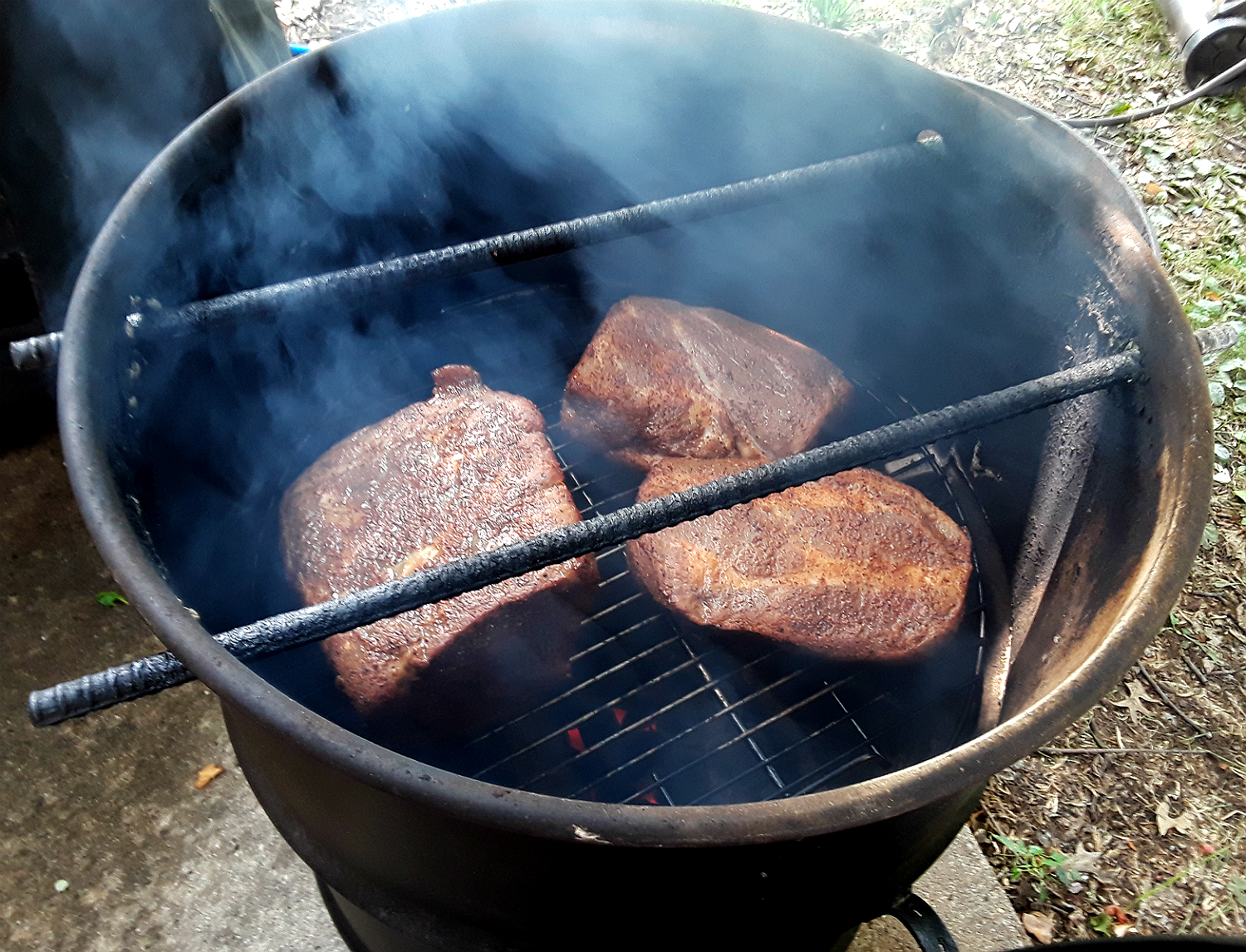
Step 2: Fire up your smoker and put the pork on for a good four hours.

Step 3: Cook the pork in a pressure cooker on high with a half-cup of Stubb’s Pork Marinade and a half-cup water for 50 minutes. You’re essentially steaming the pork tender.

Step 4: Remove from the liquid and pull apart or chop up the pork. Add fresh Stubb’s Pork Marinade at a rate of one tablespoon per pound of finished pork. Adding this last bit of fresh marinade is like adding finishing salt to a salad; it just gives it a little something extra. Do NOT add back any of the liquid from the pressure cooker. That will overpower the lovely flavor of the pork and smoke.

Notes:

My nephew’s wedding party.

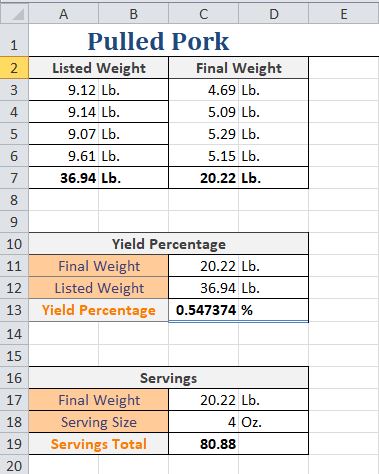
It’s really useful to keep notes on the finished weight of your efforts in order to calculate the yield percentage of your system. After a few samples, you can get a good idea of how much finished product you can expect and make calculations about how many servings you will have. Most of the experts I could find said to figure on four ounces per person as a serving size. That works out to about two buns-worth per person.

I personally think the only topping needed is pickled red onions and maybe some Carolina Vinegar Sauce. Putting a heavy barbecue sauce on meat this good just drowns out the flavor.

The Cider Press

I don’t know why this was the thing I wanted to save from the farm but it was. As all the things were being packed up or sold off or thrown away, this was the thing I wanted to remind me of the farm I grew up on.

It’s not a very practical thing to lug around. It’s top heavy. It weighs a lot. I’ve pretty much lugged it around myself. I’ve never used it these last 20 years.

I remember when Dad got it in the summer of 1977, just before I turned 15. I don’t know where he found it or why he thought it was important, but I went with him to pick it up from a guy who repaired it on a farm a ways north of Highway 18 and a few miles east of Highway 15, just north of Whittemore, Iowa. I seem to remember Dad paid about $300 for it.

In hindsight, it was not a very practical thing to buy. In a few short years he would be getting eaten alive by 21% interest rates during The Farm Crisis. We only had two small apple trees in the backyard and only one made juice worth drinking. But for the next few years, for a few short weeks, the sweet, tangy, fleeting taste of summer ending was something Mom, Dad and I created and enjoyed together.

I’m at about the same age now as Dad was then. I was a small business owner when the economic meltdown of 2008-2009 hit and I got beaten up in ways I haven’t recovered from. The Farm Crisis of the ’80s was no more his fault than The Great Recession was mine, but it does seem like I’m reliving a pattern not of my making. I’ve been lugging that around for a lot of years too.

Once in a while I’ll get a brief flash of memory of what it was like to be that 15 year old who had potential. I suppose the hiring managers who are almost half my age are embarrassed for me now.

I’m not ready to give up even if others do not see me as having value. I’ll keep that cider press with me. It still has the potential to create something special.

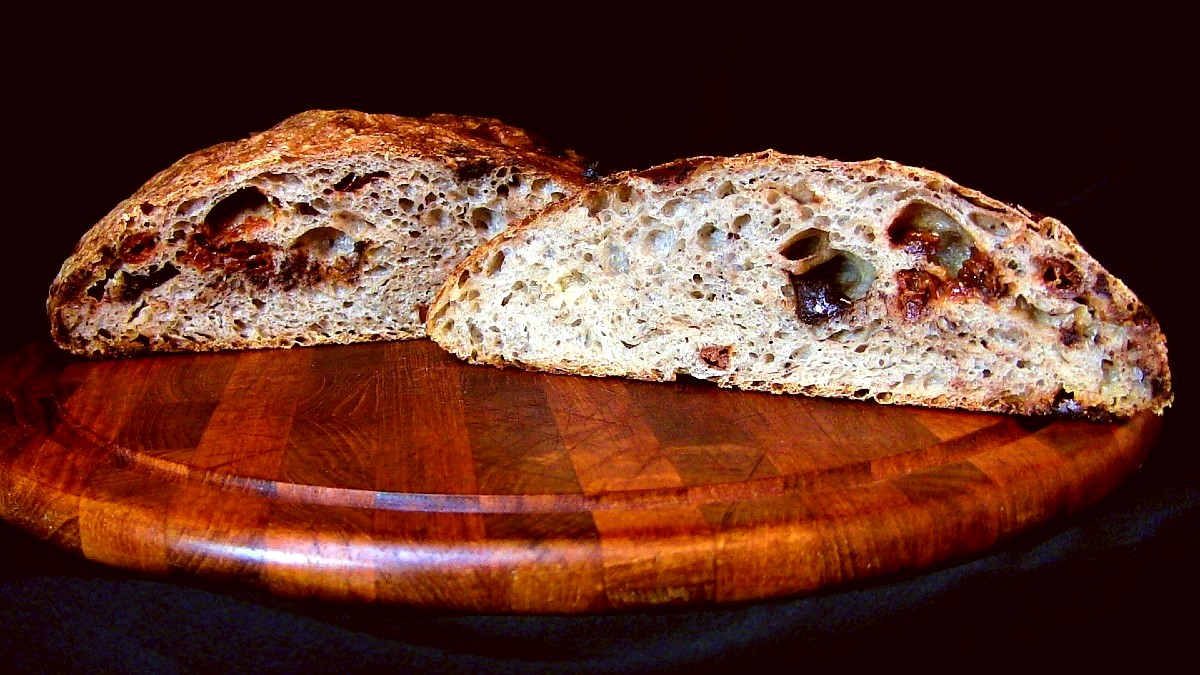
No-knead Chocolate Cherry Bread

The inspiration for this bread has its roots in the braided chocolate cherry bread Paul Hollywood did for a Masterclass during the 2014 season of “The Great British Bake Off” and from an interview with Nathan Myhrvold at the end of an episode of the “The Food Programme” podcast from the BBC. Myrhvold said his favorite bread was a sourdough chocolate cherry bread. No-knead breads are a kinda-sorta way of cheating sourdough. Kinda.

Ingredients:

  • 454 grams (1 lb.) All-Purpose or Bread Flour
  • ¼ tsp. Yeast
  • 2 tsp. Sea Salt
  • 1 tbsp. Ground Cocoa
  • 43 grams (1.5 oz.) Semi-Sweet Chocolate, chopped into chunks
  • 43 grams (1.5 oz.) White Chocolate, chopped into chunks
  • 45 grams (⅓ cup) dried Cherries
  • 340 grams (12 fl. oz.) Water

Directions:

Step 1: Combine dry ingredients.  Add chunks of chocolate, white chocolate and dried cherries and mix. Add water and mix by hand just until the mix holds together without working the dough. You do not want to develop the gluten.

Step 2: Set aside in a food-grade container, cover with plastic wrap or a lid and let ferment at room temperature for 24-36 hours.

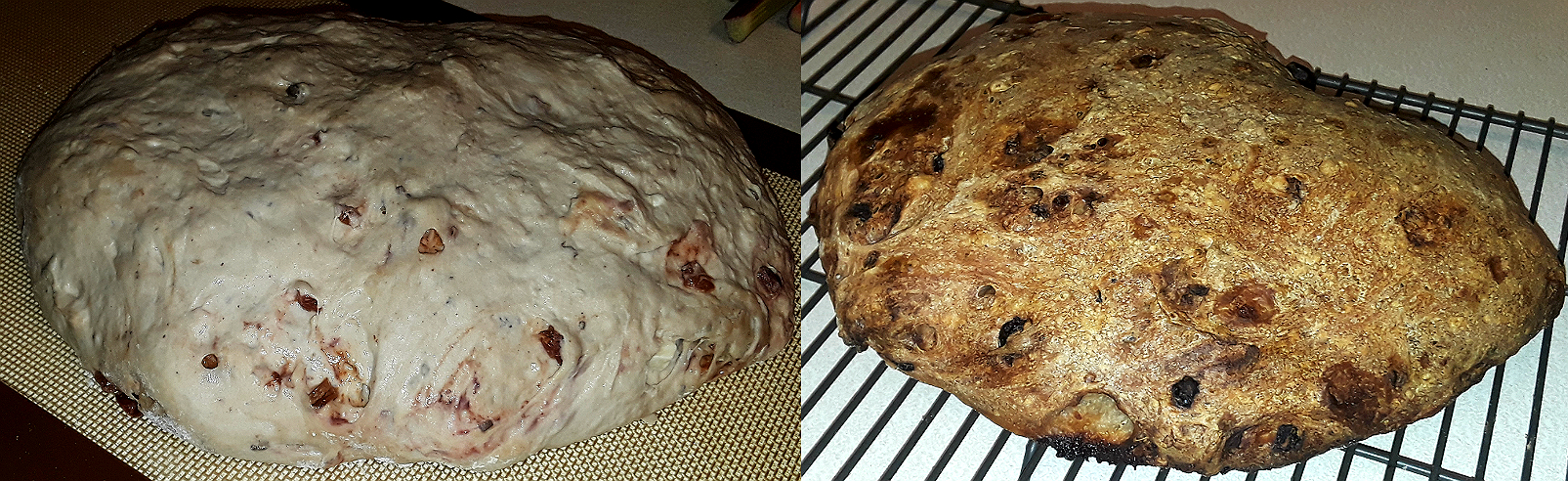
Before and after letting a tiny amount of yeast do its thing for 24 hours.

Step 3: Dust your surface with flour and shape into a ball. Transfer to a baking sheet covered with parchment paper or a silicone mat dusted with flour. Let prove for about an hour.

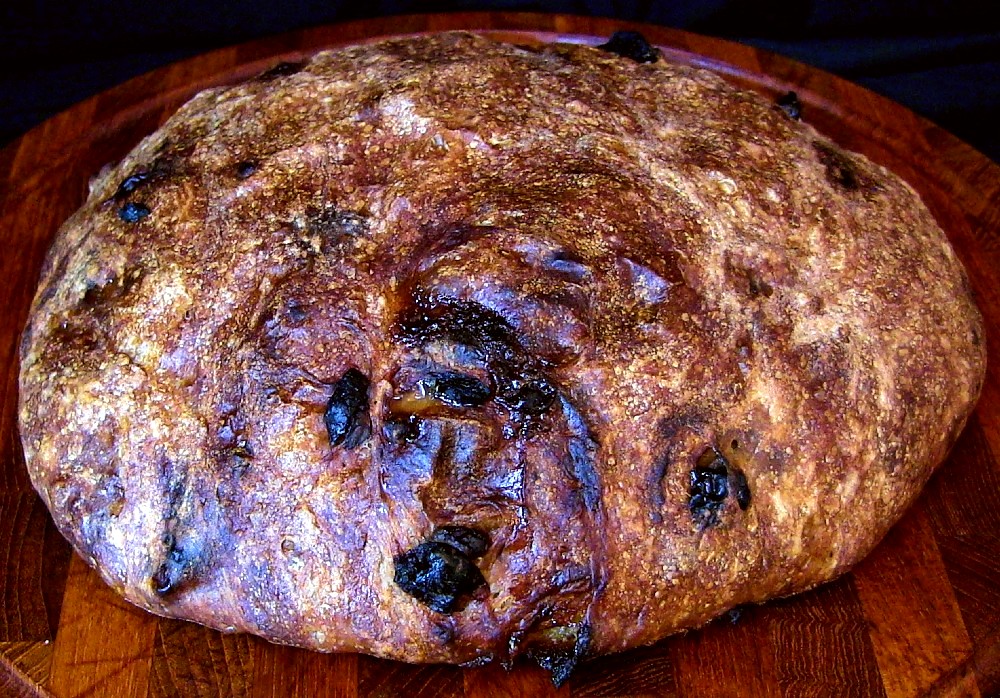
Step 4: Preheat the oven to 450°F. Bake for 35-40 minutes***. Use a spray bottle to give 15 spritzes of water in the oven every five minutes. This helps develop a chewy crust. Turn the bread around half-way through the bake in order to insure even baking. Let cool on a wire rack.

***Because ovens can vary on their temperature, the baking time can be between 35-40 minutes. I generally bake it for 35 minutes and that leaves the interior a little on the moist side. It’s really a matter of preference.

Notes:

No-knead breads exploded when Mark Bittman wrote an article about them for the New York Times and you can read more about that phenomenon at his website. By using a tiny amount of yeast and not developing the gluten through kneading, no-knead breads develop a structure with large holes characteristic of artisan breads. Longer fermentation times develop stronger flavors.

I’ve dialed back the hydration level a bit to make the dough easier to work with and I’ve experimented with the length of fermentation. For my taste, 24-36 hours is the sweet spot. When I’ve let it go 48 hours or longer the texture gets a bit gummy.

This bread is an ENORMOUS crowd-pleaser.

Cooking is Drudgery.

I like being a home cook. People mean it as a compliment when they say, “You could sell this,” or, “You should enter a contest,” but I think, maybe, what’s behind that – unconsciously – is the notion that what you’re doing is not valid unless you are doing it to make money or to dominate someone else. I mean, you can’t do cooking because it makes you happy, right?

During a recent podcast of The Food Programme from the BBC, the founder of the Moley Robotic Kitchen, Mark Olynik, described how people will be able to download a dish from a celebrity chef for a small fee just like downloading a song. His kitchen robot will then be able to cook the dish exactly like the celebrity chef has specified. He said it will eliminate boring food preparation and give you more time to spend on something that will make you happy.

Moley Robotic Kitchen has teamed with Tim Anderson, a past winner of the BBC show MasterChef, and has programmed a robot to copy him making a dish the same way Hollywood copies an actor’s movements when creating animated special effects. Anderson said that a robot could be programmed for fine dining or for nostalgic cooking. He said that if a robot could be programmed to make Wisconsin Beer Cheese Soup the way he remembered, it would make him happy.

It’s interesting that both men gave “Happiness” as a reason for robots taking over the role of cooking. According to one British Columbian study, out of 66 leisure activities that contribute to a person’s sense of well-being, cooking was the best predictor of happiness. A study of amateur chefs reported that cooking allowed them to express their creativity and feel good about themselves.

Grocery industry researcher Eddie Yoon reports that 90% of Americans either hate to cook or are lukewarm about it, yet the British Columbian study shows that cooking as a leisure activity is the best predictor of happiness. What gives? People are fascinated by what they see on TV about cooking, but TV cooking is mostly about the spectacle of food warriors in combat and not about real people creating dishes in real kitchens. Madison Avenue has drilled the message that “cooking is drudgery” into American minds for decades and they have been successful in convincing people that home cooking is a chore and a waste of leisure time.

McDonalds has a commercial out for their delivery service that says, “We deliver Happy.” Like rats on the hedonic treadmill, advertisers want to brain wash people into giving up an activity that will actually make them happy in order to be a consumer of something that will make them less and less happy over time.

There’s a school of thought that says people need three things for psychological health:

  • Autonomy: feeling in control of behavior and goals.
  • Competence: gaining mastery of tasks or skills.
  • Relatedness: feeling a sense of belonging or attachment to others.

Being a home cook satisfies the first two criteria and the act of cooking for others satisfies the third. There’s a real chance that home cooking will become a niche hobby like knitting. What will we lose by giving up a creative activity that gives us real happiness for yet another consumer activity that leaves us empty?

Michalos, C.A. (2005). Arts and the quality of life: An exploratory study. Social Indicators Research, 71, 11-59.

Daniel, M., Guttmann, Y., Raviv, A. (2011).  Cooking and Maslow’s Hierarchy of Needs: A qualitative analysis of amateur chefs’ perspectives. International Journal of Humanities and Social Science Vol. 1 No. 20

https://hbr.org/2017/09/the-grocery-industry-confronts-a-new-problem-only-10-of-americans-love-cooking

How to Make Kimchi.

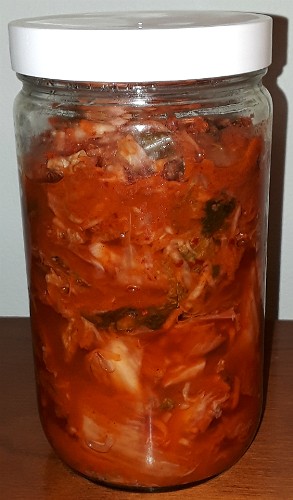
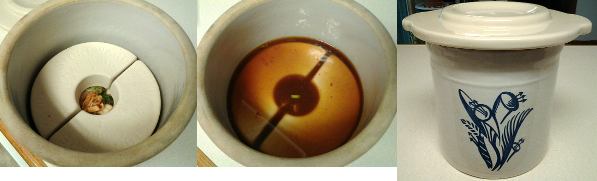
Kimchi Jar

Ingredients

  • 3 – 3 ½ lb. Napa Cabbage, torn into bite-size pieces
  • 1 lb. Radishes, shredded
  • 1 lb. Carrots, shredded
  • 8 Spring Onions, chopped
  • 1 bulb Garlic, chopped
  • 3 tbsp. Himalayan or Redmond Real Salt (about 3% by weight of the produce)
  • 1 tbsp. Korean Chili flakes*
  • 1 tbsp. Sugar
  • ⅓ cup Gochujang Paste
  • ⅓ cup Soy Sauce
  • ⅓ cup White Vinegar

*Korean chili flakes, or Gochugaru, are bright red and feature less heat than crushed red pepper. Adjust accordingly if substituting. Aleppo pepper would be a comparable substitute.

Remove outer layers of Napa cabbage and any signs of wilting. Cut off the end of the core, wash the leaves, and tear into bite-size pieces by hand. Toss with 3 tbsp. Himalayan or Redmond Real Salt in a large bowl. Shred carrots and radishes with a food processor. Chop onions and garlic and add to cabbage along with remaining ingredients and mix. The salt should have extracted some of the water from the cabbage while the other ingredients were being prepared. Add to fermenting vessel and place weight on top of the kimchi. Liquid should cover the kimchi fairly quickly. Cover with lid and leave to ferment, preferably around 60° F, for a minimum of one week. Longer fermentation times will enhance sourness and depth of flavor.Transfer to jars and refrigerate. Makes 3 quarts.

I use a one-gallon crock I already owned and purchased the weights and lid separately. They are made by the Ohio Stoneware company and their products can be purchased online through Ace Hardware and delivered to a nearby store.

I find the human evolution lesson of fermented foods to be fascinating. Fermenting foods is about creating an environment where the “good” bacteria – the “pro” of probiotics – can thrive and discourages the growth of the “bad” bacteria that causes food to spoil and makes us sick.

Probiotic bacteria is naturally on the surface of our fresh fruits and vegetables, even the non-organic ones in the big box grocery stores. Our bodies do not manufacture the good bacteria that is necessary for proper digestive function and it is important to get them through diet or supplements. They are also what makes fermented foods safe to eat months after they have been created and were vital to our survival as a species because of our need to preserve food.

Salt is central to making the whole thing work. Adding the proper amount of salt – about 3% by weight – to vegetables creates a pH environment that bad bacteria do not like and they find it difficult to thrive. Salt also draws water out of our veggies and placing a weight on top of fermenting foods creates a liquid barrier between any airborne nasty bacteria and the happily fermenting produce beneath the surface. I say happily because probiotic bacteria love the pH environment created by adding salt. As they munch away, they produce lactic acid which further discourages the growth of bad bacteria, adding to the value of food preservation.

Our bodies interacted with our environment in such a way that we need probiotics for digestive function and our taste buds recognize salt as one of our most important flavors. Apart from survival, fermented foods offer a potent and complex taste sensation.

I’ve adapted this recipe for my own taste buds and according to the availability of ingredients. I don’t get too hung up on authenticity because…well…I don’t live in Korea. Some people may not think my kimchi is hot enough, but I quit thinking of hot foods as a dare a long time ago and this is just about right for my Midwestern palette.

It really is remarkable how well this preserves fresh produce. If you only have one or two people in your household, getting through a big bag of mixed greens before it spoils can be iffy sometimes. I once discovered a jar of homemade kimchi in the back of the refrigerator that was six months old and it was still perfectly delicious.

Design a site like this with WordPress.com
Get started