
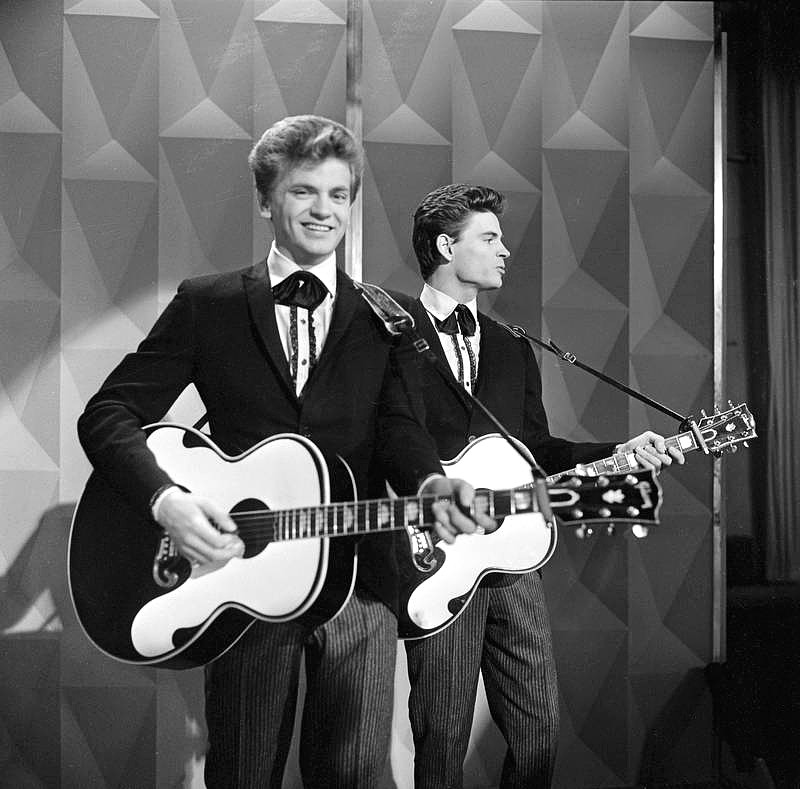
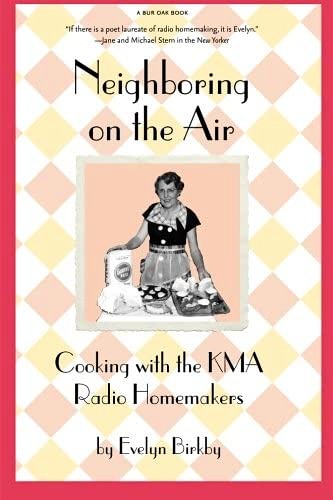
The Everly Brothers began their Hall of Fame careers playing music while young boys on KMA Radio in Shenandoah, Iowa on the Everly Family Show with their father, Ike, and mother, Margaret, in the 1940s. Many years later, Margaret Everly submitted family-favorite recipes to a book that told the story of KMA Radio and the radio homemakers who shared recipes and household management tips to a large midwestern audience. The program, “Kitchen Klatter,” became the longest-running homemaker program in the history of radio. Iowa Public Television made a documentary based on the book, “Neighboring on the Air: Cooking with the KMA Radio Homemakers” by Evelyn Birkby, which includes favorite recipes from the Everly family.
Ike Everly began working in the coal mines of Muhlenberg County, Kentucky when he was 14 years old. Ike had a talent for music and helped develop a three-finger guitar playing style that was unique to Muhlenberg County and has since been imitated far and wide. He’s now considered to be one of the most influential guitar players of the 20th century. (See Notes after the recipe) He began playing locally in Kentucky and eventually made his way to Chicago where he gained experience in nightclubs and radio.
Margaret grew up three houses away from Ike in Brownie, Kentucky and married Ike when she was 15 years old and Ike was 26. They knew they didn’t want to raise a family in Chicago and made their way west to Waterloo, Iowa. Seeking a smaller town to raise their children, they heard of the radio station in Shenandoah, Iowa that employed musicians for their broadcasts. Ike contacted the station manager of KMA Radio and secured a job.
Starting in 1945, the Everly’s spent eight years performing on KMA Radio. Phil and Don were six and eight years old when they began making appearances on KMA Radio. A few years later, the whole family began performing live on the Everly Family Show which aired at 5:30 in the morning. According to the book, “KMA Radio: The First 60 Years,” by Robert Birkby, Margaret Everly recalled:
“Early in the morning Ike would go out to start the car to get it warm while I made hot chocolate for the boys. In the winter it might be sixteen below zero outside, but we never missed a show. I think we would have crawled to the studio to put that show on.”
In addition to performing on the radio, Don and Phil were active in school, had paper routes and lemonade stands, and detasseled corn in the summers. Shenandoah, Iowa was a great place to grow up but, unfortunately, by the early 1950s radio stations moved away from employing full-time musicians and the Everly’s had to move on.
They made their way to Tennessee in 1953 and performed on small radio stations where they came to the attention of Chet Atkins. With help from Atkins, the Everly Brothers signed with Cadence Records and in February, 1957, they recorded “Bye, Bye Love” which shot up to No. 2 on the pop charts behind Elvis Presley’s “Teddy Bear.” It became their first of many million-selling records.
The importance of radio to rural America cannot be overstated and the history of KMA Radio is a fascinating one. Margaret Everly included recipes for fried chicken and fried oysters in the book commemorating the homemakers of KMA Radio, but I’ve decided to highlight the recipe she submitted as Phil Everly’s favorite dessert.
This recipe makes a LOT of custard and I would cut way back when making it again. I’d also use more vanilla extract and go with a thicker graham cracker crust. However, the goal was to try and recreate this as accurately as possible. I’ve made a slight alteration from the original recipe by increasing the amount of egg whites used in the meringue to adequately cover the whole dish. I’ve also simplified the cooking instructions somewhat.
Directions:
Crust
- 140 grams (1 package or 9 cracker sheets) Original Nabisco Graham Crackers, crushed into crumbs for the base
- 48 grams (3 cracker sheets) Original Nabisco Graham Crackers, crushed into crumbs for topping
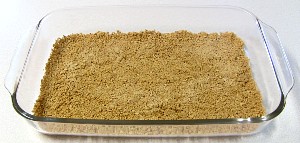
Crush one package of graham crackers into crumbs and form a crust in the bottom of a standard 13 x 9 x 2 inch baking dish. Crush an additional three sheets of graham crackers and reserve for a topping.
Filling
- 248 grams (1 ¼ cups) Granulated White Sugar
- 30 grams (¼ cup) All-Purpose Flour
- 2 tbsp. Cornstarch
- 3 ½ cups Milk
- 2 Egg Yolks, lightly beaten
- 2 tbsp. Butter, melted
- 1 tsp. Pure Vanilla Extract
- 4 to 5 Bananas, sliced
Combine sugar, flour and corn starch, then mix in the beaten egg yolks. Add milk and mix thoroughly. Slowly heat the mixture while stirring constantly in order to avoid scrambling the egg yolks. Heat to bubbling and continue stirring for about two to three minutes until it thickens enough to coat the back of a spoon. Remove from heat, add melted butter and vanilla and allow to cool somewhat. It should take on a pudding-like consistency fairly quick.
Meringue
- 4 Egg Whites
- 4 tbsp. Granulated White Sugar
- ¼ tsp. Cream of Tartar
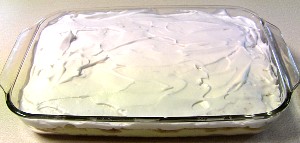
Beat the egg whites until foamy, then gradually add the sugar and cream of tartar. Continue until you have stiff peaks.
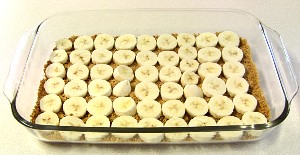
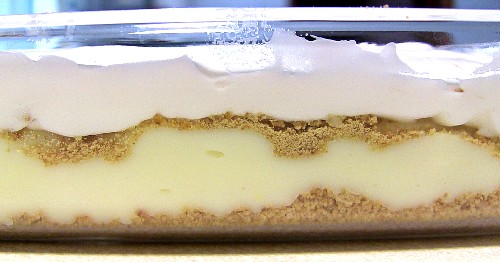
Preheat the oven to 350°F. Arrange enough banana slices to cover the graham cracker crust. Spread on half the custard. Repeat with another layer of bananas and the rest of the custard. Sprinkle the custard with the reserved graham cracker crumbs.
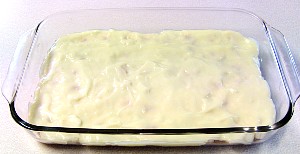
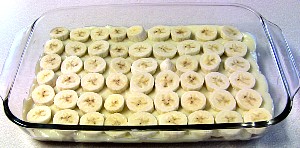
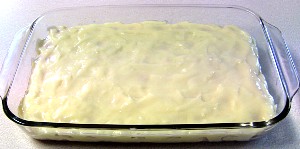

Spread on the meringue and bake for about 15 minutes until light brown on top. Let cool on a wire rack.

Notes:
I first thought that doing a post about a recipe from one of the Everly Brothers was, on the face of it, just kind of quirky and funny. As I dug into the story a little bit, it took me down a path I hadn’t seen coming.
I grew upon a farm in Iowa and have always had an interest in history, yet my knowledge of the Everly Brother’s connection to Iowa history did not extend much beyond what is the standard Chamber of Commerce template version of all local history in Iowa:
“Come to [name of town] – Boyhood Home of [famous person] – and while you’re here enjoy our many shopping opportunities.”
What was a revelation to me when I started doing research was the little-noticed importance of Ike Everly’s place in the history of American music. He never hit the big time, but he ranks alongside such giants of American Folk Music as Doc Watson and Merle Travis.
Ike Everly was one of four people, along with Arnold Schultz, Kennedy Jones and Mose Rager, who were largely responsible for developing a three-finger guitar playing style that Everly and Rager taught to fellow-neighbor, Merle Travis, while working in the coal fields. Merle Travis went on to become a giant in American music. He wrote the song, “Sixteen Tons,” that was on an album of coal mining songs he made and his guitar playing influenced Chet Atkins, who was largely responsible for the Everly Brothers getting their first big break.
The playing style Ike Everly helped develop influenced countless musicians during the Folk Music Revival of the 1950s and ’60s. Johnny Cash called him one of the most influential guitar players of the 20th Century.
I came across an article ranking 10 Great Musical Moments from the Newport Folk Festival Since 1959 and his performance with his sons, Don and Phil, in 1969 comes in at No. 5 on the list. For some perspective, Bob Dylan’s famous “going electric” performance ranks as No. 3.
What first got my attention was the fact that he was from Muhlenberg County, Kentucky. It immediately brought to mind the John Prine song, “Paradise” and the verse:
Daddy, won't you take me back to Muhlenberg County
down by the Green River
where Paradise lives.
Well, I'm sorry my son
but you're too late in askin'
Mr. Peabody's coal train has hauled it away.
The song is based on the true story of Paradise, Kentucky, a town that was literally scraped out of existence by coal mining.
Ike Everly started working in the coal mines when he was 14 years old and it was Black Lung Disease that claimed him in the end. But he had talent, and his talent allowed him to escape the bone-punishing grind of coal mining and give his family a chance at a better life.
Ike Everly quite possibly could have achieved greater fame and fortune for himself had he stayed performing on radio in Chicago as Merle Travis had done in Cincinnati. However, the biggest priority for Ike and Margaret Everly was to find a nice small town where they could raise their children.
Margaret Everly alluded to their life in Shenandoah, Iowa as having been an idyllic time and that they may never have left had the changes in the radio industry not necessitated their move. She outlived both her sons and passed away in 2021 at the age of 102. She spoke highly of their time in Shenandoah, Iowa to her grandchildren until the end of her life.
I find the story of Ike and Margaret Everly to be quite moving and poignant. I’m not the only person with a rural background who’s experienced a sense of loss at realizing that one can’t go home again because the old place doesn’t really exist anymore.
Some of my interest in old recipes is an attempt to capture a bit of what that old aura was like and to keep a little sense of it going.
There’s some old clips from The Johnny Cash Show that have Ike Everly playing his unique guitar style. The clips are a little ragged, but worth watching if you’re into Americana music.
This is an hour-long set of Ike Everly with his sons, Don and Phil, at the Newport Folk Festival from 1969.


Looks and sounds like a great dessert to be shared with!
The cream of tartar…I sometimes see it as an ingredient in baking, but I barely see it here in the west coast of the States. Do you use it often?👀💕
LikeLiked by 1 person
This is the first time I’ve ever used cream of tartar. I’ve made meringue a few times and I think the cream of tartar made the meringue stiffer and more shiny. At least I think so.
LikeLiked by 1 person
Oh really! So maybe cream of tartar isn’t that must-have for all kitchen?🤔 I need to find out what other ways I can use it👀✨
LikeLiked by 1 person